
Custom AI Agents & Agentic Workflows with Claude Code: The 2026 Expert Guide**
Introduction
The evolution of AI in 2026 has moved far beyond simple chatbots.
We are now in the era of agentic systems — intelligent, autonomous AI agents capable of planning, reasoning, executing tasks, and collaborating across workflows.
For developers, founders, and SaaS builders, this shift unlocks a powerful opportunity:
👉 Build self-operating systems instead of static applications.
This guide breaks down how to design, build, and deploy custom AI agents and agentic workflows using Claude Code, with a strong focus on real-world implementation.
What Are Custom AI Agents?
A custom AI agent is an intelligent system that can:
- Understand goals (not just prompts)
- Break tasks into steps
- Execute actions via tools/APIs
- Adapt based on results
- Maintain context over time
Unlike traditional bots, agents are goal-driven, not just reactive.
Example:
Instead of:
“Reply to user question”
An AI agent:
Receives a support request → identifies intent → checks database → generates solution → sends response → logs interaction
Understanding Agentic Workflows
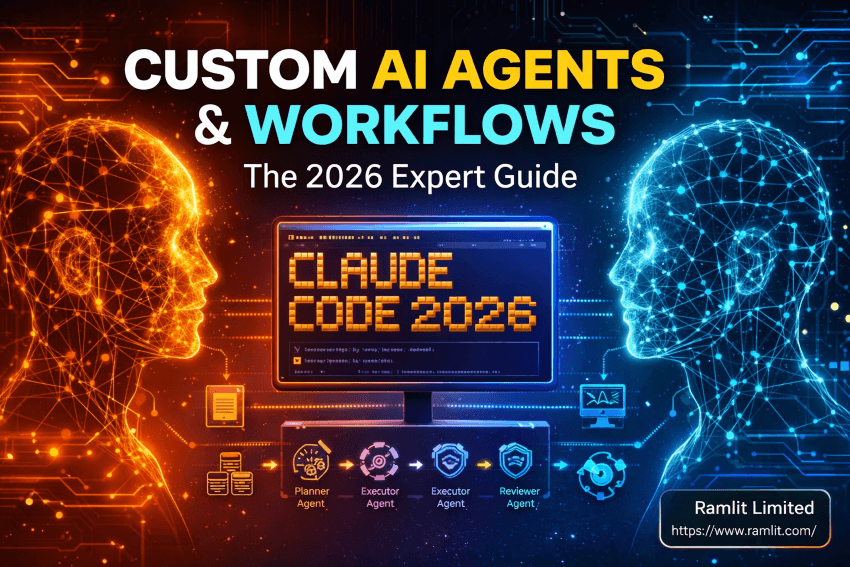
An agentic workflow is a structured system where one or multiple AI agents collaborate to complete complex tasks.
Core Components:
-
Planner Agent
- Breaks down high-level goals into tasks
-
Executor Agent
- Performs actions (API calls, DB queries, automation)
-
Reviewer Agent
- Validates outputs and improves quality
-
Memory Layer
- Stores context, past actions, and learning
-
Tooling Layer
- External integrations (APIs, databases, services)
Why Claude Code for Agentic Systems?
Claude Code is becoming a preferred choice for building agent workflows due to:
- Strong reasoning capabilities
- Long-context understanding
- Structured output handling
- Safe and controllable execution
Key Advantages:
✔ Better multi-step reasoning ✔ Reliable code generation ✔ Context-aware decision making ✔ Ideal for multi-agent collaboration
Architecture of an Agentic System
A production-ready AI agent system typically follows this architecture:
User Input
   ↓
Router / Intent Classifier
   ↓
Planner Agent
   ↓
Task Queue
   ↓
Executor Agents
   ↓
Tool/API Layer
   ↓
Memory Storage (Vector DB / Cache)
   ↓
Reviewer Agent
   ↓
Final Output to User
Recommended Stack:
- Frontend: React / Next.js
- Backend: FastAPI / Django / Laravel
- AI Layer: Claude Code + LLM APIs
- Memory: Vector DB (or optimized embeddings)
- Queue: Celery / Redis / Kafka
- Hosting: VPS / Cloud (AWS, GCP, etc.)
Building a Custom AI Agent (Step-by-Step)
1. Define the Agent Goal
Start with a clear objective:
- Customer support automation
- Blog/content generation
- Dev assistant
- SaaS onboarding assistant
👉 Clarity here determines performance.
2. Design the Agent Behavior
Define:
- Inputs
- Outputs
- Decision rules
- Tool access
Example:
If user asks about product →
→ Fetch product data
→ Generate response
→ Offer next step
3. Integrate Tools (Critical Step)
Agents become powerful when connected to tools:
- Database queries
- REST APIs
- Payment gateways
- CRM systems
👉 Without tools, agents are just “smart chat”.
4. Implement Memory
Memory allows agents to:
- Track conversations
- Learn user preferences
- Maintain workflow continuity
Types:
- Short-term (session-based)
- Long-term (vector storage)
5. Add Multi-Agent Collaboration
For complex systems:
- Planner → breaks tasks
- Executor → performs
- Reviewer → validates
This dramatically improves reliability.
6. Add Guardrails & Validation
Never skip this.
- Input validation
- Output filtering
- Rate limiting
- Error handling
👉 This is what separates prototypes from production systems.
Real-World Use Cases
1. AI SaaS Assistant
- Onboarding users
- Guiding feature usage
- Reducing churn
2. Automated Customer Support
- Handles 80% of tickets
- Escalates complex cases
3. AI Developer Agent
- Writes code
- Debugs issues
- Suggests improvements
4. Content Automation Engine
- Generates blogs
- Optimizes SEO
- Publishes automatically
Best Practices for 2026
Keep Agents Focused
Avoid building one “super agent”. Use specialized agents.
Use Structured Outputs
JSON-based outputs improve reliability and integration.
Monitor Everything
Track:
- Agent decisions
- Errors
- Performance metrics
Optimize Latency
- Cache responses
- Use async workflows
- Minimize unnecessary calls
Common Mistakes to Avoid
❌ Overcomplicating agent logic ❌ No memory implementation ❌ Ignoring error handling ❌ Weak prompt engineering ❌ No fallback system
Future of Agentic AI
By 2026 and beyond:
- Apps will become AI-first interfaces
- Manual workflows will disappear
- Agents will act as digital employees
- SaaS products will evolve into autonomous platforms
👉 The question is no longer “Should you use AI?” 👉 It’s “How fast can you implement it?”
Conclusion
Custom AI agents and agentic workflows are not just a trend — they are the foundation of modern software.
By leveraging Claude Code effectively, you can:
- Build smarter systems
- Automate complex operations
- Deliver exceptional user experiences
- Gain a serious competitive advantage
If you're building web apps or SaaS in 2026, agentic architecture is no longer optional — it's essential.
🚀 Call to Action
If you want help building:
- AI agents
- SaaS automation systems
- Full-stack AI products
Feel free to reach out — let’s build something powerful.
Let's Work Together
Looking to build AI systems, automate workflows, or scale your tech infrastructure? I'd love to help.
- Fiverr (custom builds & integrations): fiverr.com/s/EgxYmWD
- Portfolio: mejba.me
- Ramlit Limited (enterprise solutions): ramlit.com
- ColorPark (design & branding): colorpark.io
- xCyberSecurity (security services): xcybersecurity.io