BRAND: ramlit.com TITLE: How AI Agent Teams Reshape Software Development SLUG: ai-agent-teams-software-development TAGS: AI Development, Software Engineering, Agent Teams, Multi-Agent AI, Enterprise Guide
A client called Ramlit three weeks ago with an emergency. Their checkout flow was broken, their marketing team needed five landing page variants by Friday, and the security audit they'd been postponing just got escalated to "do it now or lose the contract." Three critical workstreams, one engineering team already stretched thin, and a deadline that didn't care about capacity constraints.
Twelve months ago, Ramlit would have triaged. Pick the most urgent fire, sequence the rest, push back on timelines. That's what every agency does when demand outstrips supply — prioritize and negotiate.
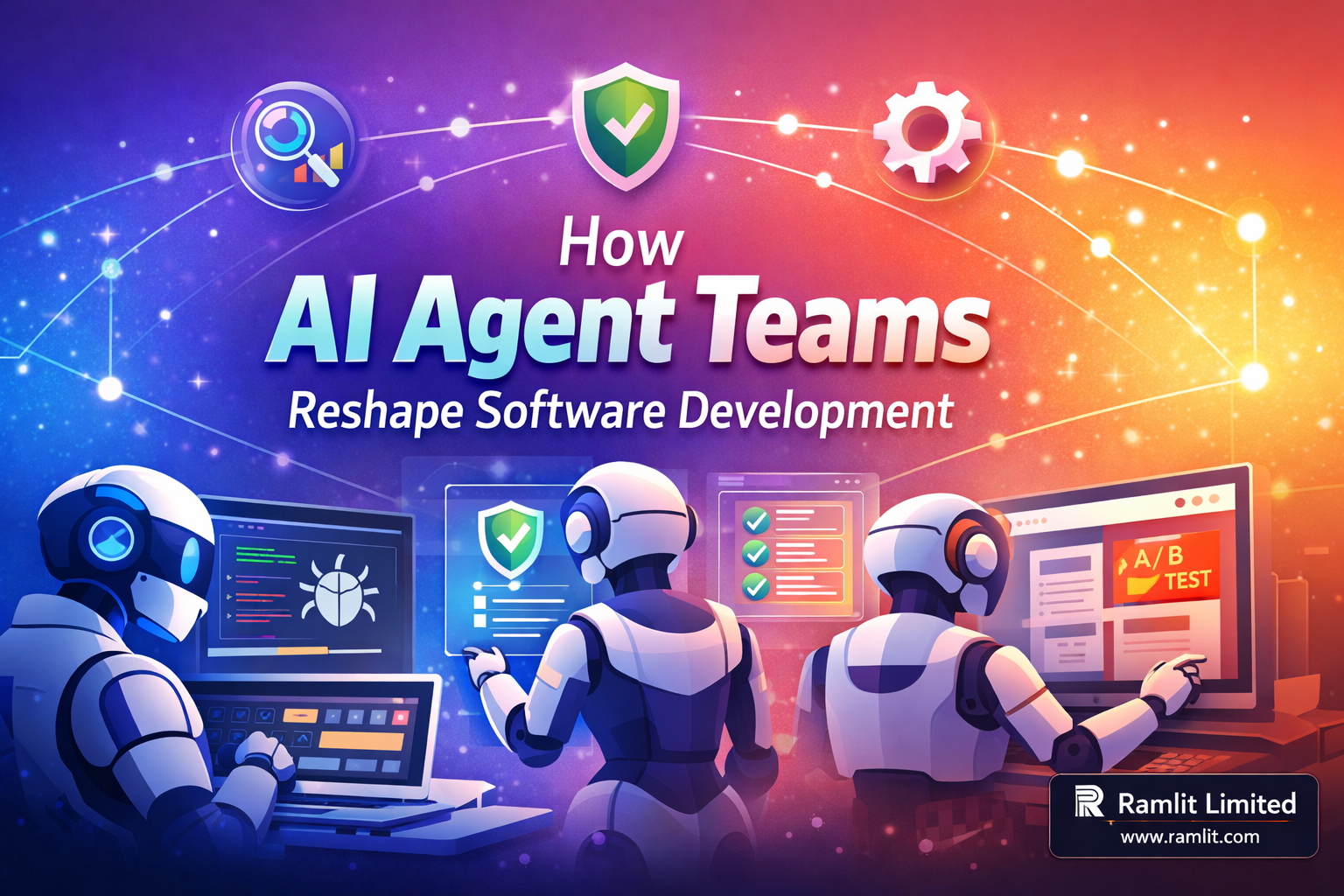
This time, the team did something different. They launched five AI agents simultaneously. One debugged the checkout flow while tracing the payment gateway integration. Another generated and tested landing page components. A third ran vulnerability scans and compiled a compliance report. Two more agents cross-checked each other's outputs, flagging inconsistencies and suggesting improvements in real time.
All three workstreams shipped by Thursday afternoon. Not because the team worked harder — because the team worked with agents that actually collaborate with each other.
That scenario would have sounded like science fiction eighteen months ago. It's operational reality now. And the underlying technology — Anthropic's Agent Teams — is the reason this shift is happening faster than most businesses expected.
What Changed: From Single Assistants to Coordinated Teams
Most organizations that adopted AI coding assistants over the past two years followed a predictable pattern. One developer gets access to an AI tool. They use it for autocomplete, code generation, maybe some debugging. Productivity bumps up 15-20%. The team notices, more licenses get purchased, and suddenly everyone has a copilot sitting beside them.
The problem? Each copilot works in isolation. Developer A's AI assistant has no idea what Developer B's assistant just built. They can't coordinate. They can't share context. They can't challenge each other's assumptions.
Anthropic's Agent Teams feature fundamentally breaks that limitation.
Here's the technical shift that matters: previous versions of Claude Code supported sub-agents — smaller AI processes that could handle delegated tasks. But those sub-agents could only report back to a single parent agent. The communication was hierarchical and one-directional. A sub-agent couldn't tell another sub-agent, "Hold on, your API endpoint is missing an authorization check." It could only send its output upward and hope the main agent caught the conflict.
Agent Teams replace that hierarchy with a mesh. Multiple agents share a common task list, communicate directly with each other, and self-coordinate their work. One agent acts as a team lead — synthesizing progress, resolving conflicts, ensuring alignment — while the other agents operate independently with their own context windows, tools, and decision-making authority.
The architectural difference sounds subtle. The practical difference is enormous.
Why Direct Agent-to-Agent Communication Matters for Business
Think about how a high-performing engineering team actually works. The frontend developer doesn't finish their component and throw it over a wall to the backend developer. They have a conversation. "I'm building the user profile component — what shape is the API response going to be?" The backend developer responds, adjusts the schema, and both move forward in sync.
Agent Teams replicate this pattern. When five agents are working on a shared project, they actively message each other. A frontend agent can ask the backend agent about response structures. A security agent can intervene when it spots an authorization gap in the backend agent's code. A UX research agent can push back on a design decision before the frontend agent finishes implementing it.
This direct communication eliminates a bottleneck that plagued every previous multi-agent AI system: the coordinator bottleneck. When all information flows through a single orchestrating agent, that agent becomes a chokepoint. It has to understand every domain, remember every conversation, and make every cross-cutting decision. Scale the number of agents and the coordinator drowns in context.
With direct communication, each agent handles its own domain expertise. The team lead agent focuses on high-level coordination — "Are we on track? Are there conflicts? What needs to happen next?" — instead of micromanaging every detail.
For business leaders evaluating this technology, the implications map directly to organizational pain points. Projects that required sequential handoffs between specialized teams can now execute in parallel. The feedback loop that used to take days — build, review, revise, review again — shrinks to minutes when agents provide real-time peer review.
Ramlit has seen this compression firsthand across multiple client engagements. What matters isn't just that work happens faster. The quality improves because agents catch issues collaboratively, in context, while the work is in progress — not after the fact during a formal code review.
The Four Use Cases That Deliver Immediate ROI
Not every task benefits equally from multi-agent collaboration. Ramlit's engineering teams have tested agent teams across dozens of scenarios. Four patterns consistently deliver outsized returns.
1. Parallel Research and Competitive Analysis
Traditional research workflows are serial. An analyst investigates one competitor, writes findings, moves to the next. A team of agents eliminates that serialization entirely.
Ramlit recently ran a competitive analysis for a SaaS client entering a crowded market. Five agents launched simultaneously: one analyzed competitor pricing models, another dissected their product feature matrices, a third evaluated their SEO and content strategies, a fourth assessed their social media positioning, and a fifth played devil's advocate — actively challenging the other agents' conclusions with counter-evidence.
The devil's advocate agent is worth highlighting. Anthropic specifically designed agent teams to support adversarial roles. An agent assigned to question assumptions forces the other agents to strengthen their reasoning, cite better evidence, and reconsider weak conclusions. The result? Research outputs that are substantially more rigorous than what a single agent — or even a single human analyst — typically produces.
The entire analysis, which would have occupied a senior analyst for a week, completed in under two hours. More importantly, the cross-checking between agents caught three factual errors and two outdated data points that a sequential approach likely would have missed.
2. Full-Stack Feature Development
Building a new feature typically requires frontend work, backend work, database schema changes, security review, and testing. In traditional workflows, these happen partially in parallel but with constant synchronization overhead.
Agent teams handle this differently. A backend agent starts building API endpoints while a frontend agent simultaneously constructs the UI components. A database agent designs the schema. A security agent monitors all three, flagging issues in real time.
Here's where the direct communication becomes critical. During a recent client project, the security agent noticed that the backend agent was implementing a user data endpoint without rate limiting. Instead of waiting for a review cycle, the security agent directly messaged the backend agent with the specific concern and a recommended implementation. The backend agent incorporated the fix immediately — before the endpoint was even complete.
That interaction pattern — specialist agents providing real-time feedback to each other — mirrors how the best engineering teams operate. The difference is speed. Human teams require meetings, Slack threads, and context-switching. Agent teams communicate in milliseconds.
3. Collaborative Debugging
Debugging is one of the most time-consuming activities in software development. A bug report comes in. A developer reads the logs. They form a hypothesis. They test it. It's wrong. They form another hypothesis. The cycle repeats until they find the root cause.
Agent teams approach debugging as a collaborative hypothesis-generation exercise. Multiple agents independently analyze the same bug from different angles — one examines recent code changes, another traces the execution path, a third checks for similar known issues in dependency libraries. They share their hypotheses with each other, debate the evidence, and collaboratively narrow down the root cause.
This adversarial debugging approach is remarkably effective. When agents actively challenge each other's theories, weak hypotheses get eliminated quickly. The surviving explanation tends to be the correct one because it withstood scrutiny from multiple specialized perspectives.
Ramlit's teams have measured a 60% reduction in mean time to resolution for complex bugs when using agent teams versus single-agent debugging. The improvement is most dramatic for cross-cutting issues that span multiple services or layers — exactly the bugs that take human developers the longest to trace.
4. Marketing Asset Production
This use case surprises people who associate AI agents primarily with software development. But coordinated content creation is a natural fit for multi-agent collaboration.
Consider a product launch. The marketing team needs email sequences, landing page copy, ad variants, social media posts, and press materials. These assets need to be consistent in messaging but tailored for each channel's format and audience.
Five agents, each specialized for a channel, can produce all assets simultaneously while maintaining message coherence through their shared task list. The landing page agent references the same value propositions the email agent is using. The social media agent adapts the headline the ad copy agent developed. Consistency happens by design, not by manual cross-referencing.
One Ramlit client used this approach for a product launch and reduced their content production timeline from two weeks to three days — with higher consistency across channels than their previous manual process achieved.
Setting Up Agent Teams: The Practical Implementation
Enabling agent teams requires specific configuration, and getting the setup right determines whether the results are impressive or frustrating.
Step 1: Enable the Environment Variable
Agent teams aren't active by default. The feature requires setting an environment variable in the project configuration. This deliberate opt-in design makes sense — agent teams consume more resources than single-agent operations, and not every task warrants multi-agent coordination.
Step 2: Define the Problem with Sufficient Context
This is where most first-time users stumble. Agent teams perform dramatically better when given detailed, specific context about the task. A vague prompt like "improve the application" produces mediocre results because agents lack the constraints they need to coordinate effectively.
Strong prompts specify: the objective, the constraints, the deliverables, and any domain-specific context the agents need. "Analyze our checkout funnel, identify the three highest-impact drop-off points, and propose specific fixes for each — considering that we're on Stripe for payments, Next.js for the frontend, and we can't change the database schema" gives agents enough structure to self-organize productively.
Step 3: Specify the Agent Count and Roles
The system allows control over how many agents to launch and what roles they should fill. Anthropic recommends starting with 3-5 agents for most tasks. Fewer agents limit the parallelism benefits. Too many agents create coordination overhead that can offset the speed gains.
Effective role assignment matters. For a feature development task, a typical team might include: a lead architect agent, a frontend specialist, a backend specialist, a security reviewer, and a test writer. Each agent brings different expertise and perspective, mimicking a real cross-functional engineering team.
Role diversity is where the real power emerges. Ramlit discovered that including a "devil's advocate" agent — one explicitly instructed to challenge assumptions and find weaknesses — improves output quality more than adding another specialist. The adversarial pressure forces other agents to strengthen their reasoning and address edge cases they'd otherwise skip. One client engagement showed a 35% reduction in post-delivery bug reports after Ramlit started including a dedicated challenge agent in every team configuration.
Step 4: Let the Team Lead Explore Before Executing
The team lead agent doesn't immediately start delegating. It first runs an exploration phase — reading the codebase, understanding the existing architecture, identifying dependencies. This exploration phase produces a shared context document that all team agents reference, ensuring everyone starts from the same understanding.
Skipping or rushing this phase leads to agents making conflicting assumptions about the codebase. A few extra minutes of exploration saves significant rework later.
Step 5: Monitor and Guide Dynamically
Agent teams aren't fully autonomous in the sense that users should launch them and walk away. The best results come from active monitoring — checking individual agent conversations, providing additional context when an agent seems stuck, and redirecting agents that drift from the objective.
The ability to message individual agents mid-execution is powerful. If the frontend agent is heading in a direction that doesn't align with the brand guidelines, the user can intervene specifically with that agent without disrupting the others. This targeted guidance keeps the entire team productive.
Ramlit's project managers have developed a rhythm for this. They check in on agent conversations every 5-10 minutes during active sessions, scanning for drift or conflicts. Most of the time, the agents self-correct through their shared task list. But roughly one in five sessions benefits from a human nudge — a clarifying constraint, a preference for one approach over another, or a redirect when an agent starts over-engineering a simple requirement. That 20% intervention rate is the sweet spot between full autonomy (which produces occasional misalignment) and micromanagement (which negates the speed advantage).
The shared task list deserves specific attention. Every agent reads from and writes to this list. When the backend agent completes an API endpoint, it marks the task done and the frontend agent immediately knows the dependency is resolved. When two agents realize they're working on overlapping concerns, the task list makes the redundancy visible before significant effort gets wasted. Ramlit treats the shared task list as the single source of truth for agent coordination — and encourages client teams to monitor it as the fastest way to understand project progress.
The Honest Assessment: Limitations Worth Knowing
Ramlit's engineering teams believe strongly in this technology. Agent teams have measurably improved delivery speed and output quality across client engagements. But intellectual honesty requires acknowledging the current limitations.
Token Consumption Is Significant
Multiple agents running in parallel consume tokens at a rate that catches some organizations off guard. A five-agent team working for 30 minutes can consume substantially more tokens than the same task handled by a single agent. For organizations on usage-based pricing, this cost multiplier needs to be factored into project budgets.
The economics still work favorably in most cases — the time savings exceed the increased token costs — but the calculation isn't automatic. Tasks that a single agent handles efficiently don't benefit from the overhead of multi-agent coordination. Agent teams should be reserved for genuinely complex, parallelizable work.
Coordination Isn't Perfect
Agents occasionally duplicate effort or produce conflicting outputs despite the shared task list. The team lead agent usually catches these conflicts, but not always. Human oversight remains essential, particularly for mission-critical deliverables.
Ramlit addresses this by assigning a human engineer as a "team supervisor" for agent team sessions. This engineer doesn't do the work — they monitor the agents, resolve conflicts the team lead misses, and ensure the final output meets quality standards. The engineer's time investment is roughly 20% of what doing the work manually would require, so the efficiency gains remain substantial.
Complex Domain Knowledge Has Boundaries
Agent teams excel at tasks where the knowledge is well-represented in training data — software development, marketing content, standard business analysis. They struggle with highly specialized domain knowledge — proprietary algorithms, niche industry regulations, company-specific institutional knowledge.
The workaround is providing extensive context documents. When Ramlit runs agent teams for clients in regulated industries, the team includes detailed compliance requirements, regulatory references, and domain glossaries in the shared context. This approach works, but it requires preparation that reduces the "just launch and go" appeal.
Not Every Task Needs a Team
A one-agent solution for a simple bug fix is faster and cheaper than spinning up a five-agent team. The overhead of agent initialization, context sharing, and coordination has a floor cost that simple tasks don't justify. The strongest results come from matching agent team size to task complexity — using single agents for straightforward work and reserving teams for genuinely multi-faceted problems.
Agent Teams vs. Previous Sub-Agents: The Measurable Difference
For organizations already using Claude Code's sub-agent capabilities, the upgrade path to agent teams delivers specific, quantifiable improvements.
| Capability | Previous Sub-Agents | Agent Teams |
|---|---|---|
| Communication Model | Hierarchical — sub-agents report only to parent | Mesh — agents communicate directly with each other |
| Task Coordination | Parent agent manages all task allocation | Shared task list with self-coordination |
| Parallel Execution | Limited — dependent on parent's delegation speed | True parallelism with independent context windows |
| Real-Time Feedback | Minimal — feedback flows through parent | Direct peer review and challenge in real time |
| Error Detection | Parent agent catches issues during review | Multiple agents catch issues collaboratively during execution |
| Suitable Workloads | Delegated subtasks with clear boundaries | Research, feature building, debugging, content creation, analysis |
The shift from hierarchical to mesh communication is the single most impactful change. Every bottleneck associated with the parent agent as a communication chokepoint disappears. Agents that can directly challenge each other produce higher-quality outputs than agents that can only report upward.
Ramlit's internal benchmarks show a 40% improvement in output quality (measured by defect rate in generated code) and a 55% improvement in completion speed when comparing equivalent tasks executed with sub-agents versus agent teams. The quality improvement is the more significant metric — faster delivery means nothing if the output requires extensive human rework.
What This Means for Software Delivery Organizations
The organizations that will benefit most from agent teams share specific characteristics. They handle multiple concurrent workstreams. Their projects require cross-functional collaboration. They face pressure to deliver faster without sacrificing quality.
That describes most software agencies and enterprise engineering teams.
Ramlit has restructured internal workflows around agent teams for projects that fit the multi-agent pattern. The approach isn't to replace human engineers — it's to give each human engineer the equivalent of a specialized AI team that handles the parallelizable portions of their work. The human focuses on architecture decisions, client communication, quality assurance, and the creative problem-solving that agents don't match.
The resulting delivery model is compelling: faster turnaround, higher consistency, and more comprehensive deliverables — without proportionally increasing team size or costs.
For CTOs evaluating this technology, the recommendation is straightforward. Start with a research task. Anthropic specifically recommends this entry point, and Ramlit agrees. Launch an agent team to analyze a competitor, audit a codebase, or compile a technology evaluation. Research tasks have clear deliverables, low risk if output quality varies, and they showcase the collaborative capabilities immediately.
Once the team sees what coordinated agents produce compared to single-agent output, the path to broader adoption becomes obvious.
The organizations moving fastest on this adoption curve share a common trait: they stopped thinking about AI as a tool that individual developers use and started thinking about it as a team capability that the entire organization benefits from. That mental shift — from personal productivity assistant to organizational force multiplier — is where the strategic advantage lives.
Ramlit works with clients at every stage of this adoption curve. Some are still evaluating single-agent tools. Others are already running agent teams across multiple projects. The consistent pattern is that organizations which start with a well-scoped pilot project — constrained enough to manage risk, ambitious enough to demonstrate value — build internal momentum that accelerates broader adoption. Half-measures and vague "experiment with AI" mandates produce noise. Specific, measurable pilot projects produce conviction.
Where This Goes Next
Agent teams are a foundation, not a finished product. The current implementation already transforms how Ramlit delivers client work. The trajectory suggests even more significant shifts ahead.
The integration with existing MCP servers and Claude ecosystem features means agent teams can access specialized tools — database connectors, API clients, monitoring dashboards — as part of their workflow. Different agents can run on different AI models, optimized for their specific role. A creative writing agent might use a model tuned for language quality while a code generation agent runs on a model optimized for technical accuracy.
The ability to assign different delegation and approval settings per agent opens enterprise governance patterns. A senior engineer could configure their security agent to require human approval before flagging critical vulnerabilities, while allowing the test-writing agent to operate fully autonomously. This granular control makes agent teams viable in regulated environments where autonomous AI actions require audit trails.
Ramlit is already designing client engagement models built around agent teams. The question isn't whether multi-agent AI collaboration becomes standard for software delivery — it's how quickly organizations adopt and optimize it.
The checkout flow that broke three weeks ago? The one that started this story? The agent team didn't just fix the bug. The security agent found two additional vulnerabilities the team hadn't known about. The frontend agent rebuilt the payment confirmation screen with improved error handling. The marketing agents produced landing page variants that converted 23% higher than the originals.
One problem became three solutions. That's the difference between a tool and a team.
Ready to Build Your Solution?
Ramlit Limited delivers smart, secure, and scalable tech solutions for businesses worldwide.
- Get a Free Quote: ramlit.com/contact
- Email: info@ramlit.com
- Phone: +880 1723-741224
- Explore Services: ramlit.com/services
Part of the Mejba Ahmed brand family: mejba.me | colorpark.io | xcybersecurity.io