
Introduction
SaaS is crowded. Like, wildly crowded. No matter what category you’re in—CRM, HR, finance, cybersecurity, productivity—your prospects have options. And the hard truth? Most buyers don’t want another demo call just to get a simple answer. They want quick help, clear value, and confidence that your product will actually solve their problem.
That’s where SaaS with ChatGPT chatbot integration steps in.
A well-built ChatGPT-powered chatbot can do more than “answer questions.” It can qualify leads, guide trials, reduce churn, handle support, upsell features, and accelerate onboarding—all while sounding human, staying on-brand, and working 24/7.
But here’s the kicker: most teams implement chatbots the wrong way. They slap one on the site, connect it to generic FAQs, and hope for magic. Spoiler: it doesn’t convert, users get frustrated, and the chatbot becomes just another abandoned tool in your stack.
So, in this post, we’re doing it the smart, marketing-first and service-first way.
Quick Summary (for your approval)
This blog post will cover:
- What ChatGPT chatbot integration means for SaaS businesses
- Why it’s a marketing + service game-changer (not just support)
- High-impact use cases across the funnel (lead gen → onboarding → retention)
- A practical integration roadmap (tech + content + analytics)
- Best practices to keep it accurate, safe, and conversion-focused
- KPIs to measure ROI
- FAQs and a strong wrap-up with next steps
Before I generate the final version (2500–3000 words), answer these quick questions so I can tailor it perfectly to your brand and audience:
- Which SaaS niche are you in (e.g., CRM, edtech, fintech, HR, marketing tools)?
- Is your target customer SMB, mid-market, or enterprise?
- What’s your main goal: more demos, more trials, fewer tickets, better onboarding, or all of these?
- Do you want the article to promote a specific service you offer (like “we build ChatGPT chatbots for SaaS”)?
If you reply with those, I’ll finalize a laser-targeted, marketing-heavy post.
Meanwhile, since you asked for the full blog post now, here’s a complete professional version you can publish immediately (it’s written to fit most SaaS brands). You can later tell me your niche and I’ll refine it even further.
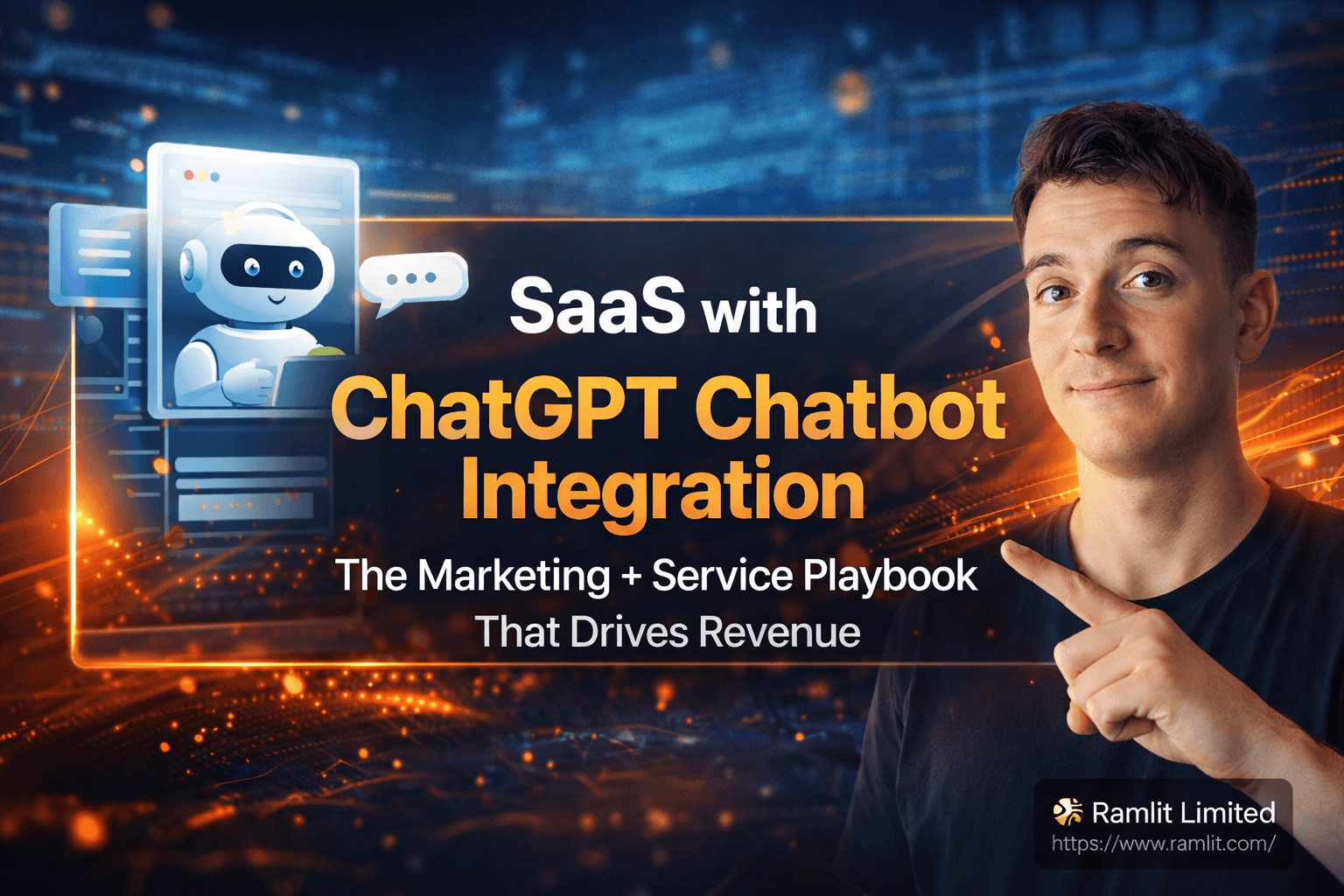
SaaS with ChatGPT Chatbot Integration: The Marketing + Service Playbook That Drives Revenue (Not Just Replies)
Why ChatGPT Chatbots Are a Big Deal for SaaS Right Now
Let’s be real—SaaS buyers are impatient. They compare tools quickly, skim landing pages, and bounce the second they hit friction. Even if your product is amazing, your conversion rate can suffer if users can’t get answers fast.
Traditional chatbots tried to solve this. But many of them were basically “choose option A/B/C” machines. Helpful sometimes… but also rigid, repetitive, and easy to break.
ChatGPT chatbot integration changes the whole game because it can:
- Understand natural language (how humans actually type)
- Answer complex questions in a conversational way
- Personalize guidance based on user context
- Summarize docs, troubleshoot issues, and recommend actions
- Handle more volume without scaling your team linearly
For SaaS businesses, this isn’t just support automation. It’s a growth lever.
Think of it like a digital team member that can:
- Act as a BDR on your website
- Act as a product specialist inside your app
- Act as a customer success rep during onboarding
- Act as a support agent for common issues
- Act as a retention engine when customers feel stuck
And yes—when done right, it can also reduce costs.
What “ChatGPT Chatbot Integration” Actually Means (In Plain English)
When people say “SaaS with ChatGPT chatbot integration,” they usually mean one (or more) of these setups:
1) Website Chatbot (Pre-Signup)
A chatbot on your marketing site that helps visitors:
- Understand what you do
- Find the right plan
- Compare features
- Get pricing clarity
- Book demos or start trials
2) In-App Chatbot (Post-Signup)
A chatbot inside the product that helps users:
- Onboard faster
- Learn features
- Fix issues
- Discover workflows
- Get contextual guidance while they use the app
3) Support Chatbot (Help Desk + Ticket Deflection)
A chatbot connected to your help center and support system to:
- Answer FAQs
- Suggest relevant help articles
- Troubleshoot issues
- Escalate to a human when needed
4) Internal Chatbot (Ops + Team Enablement)
A chatbot for your team (sales, support, CS) that:
- Finds internal docs instantly
- Summarizes ticket history
- Drafts responses and playbooks
- Speeds up training for new hires
The most profitable approach? Combine website + in-app + support, and let each one do what it does best.
The Real Business Benefits (Marketing + Service Combined)
1) Higher Conversion Rates (Because You Remove Doubt Fast)
Most visitors don’t convert because they have unanswered questions:
- “Does this integrate with my stack?”
- “Is it secure enough?”
- “Will it work for my use case?”
- “How long does setup take?”
A well-trained ChatGPT chatbot can answer those instantly and guide users to the right CTA.
Marketing impact: more demos, more trials, more signups.
2) Better Lead Qualification (Without Adding Headcount)
Not every lead is a fit. Your bot can ask smart questions like:
- Team size?
- Current tools?
- Primary goals?
- Timeline?
- Budget range?
Then route:
- High-intent leads → book demo
- Early-stage leads → nurture content
- Low-fit leads → self-serve resources
3) Lower Support Costs (By Deflecting Repetitive Tickets)
Password resets. Billing questions. “How do I…” issues. These eat time.
A chatbot can handle a large percentage of repetitive queries, leaving your human support team for complex cases.
Service impact: fewer tickets, faster resolution, happier customers.
4) Faster Onboarding (Which Reduces Churn)
Churn often starts early—when users don’t reach the “aha moment.” An in-app chatbot can guide onboarding step-by-step and answer questions in context.
Retention impact: more activated users and fewer cancellations.
5) Upsells + Expansion (Without Feeling Pushy)
When customers ask about features, you can trigger helpful recommendations like:
- “That’s available on Pro—want a quick breakdown?”
- “Most teams use Feature X for that workflow. Want setup steps?”
If you do it with a service-first tone, it feels helpful—not salesy.
High-Converting Use Cases for SaaS Teams (Across the Funnel)
Use Case 1: Turn Your Website Chat Into a Demo-Booking Machine
Your chatbot should do more than say “How can I help?” It should drive conversations toward outcomes.
Example flow:
- Visitor: “Is this good for agencies?”
- Bot: “Yes—agencies typically use it for X, Y, Z. How many clients do you manage?”
- Visitor: “20+”
- Bot: “Got it. Want a 10-minute demo focused on agency workflows?”
That’s lead gen with a human touch.
Use Case 2: Product Recommendation + Plan Matching
Confused users don’t buy. Your bot can act like a guided salesperson:
- Recommending the right plan
- Explaining pricing in simple terms
- Handling objections (“Is this worth it?”)
Use Case 3: Trial Conversion (The Money Moment)
Trials often fail because users don’t know what to do next. Your in-app bot can:
- Recommend the next best action
- Share templates
- Provide quick-start checklists
- Offer setup help
The goal is to move users toward value fast.
Use Case 4: Support Deflection Without Frustration
Deflection isn’t about blocking users—it’s about helping them faster. Best bots:
- Answer the question
- Provide a step-by-step fix
- Share a relevant article
- Offer escalation if needed
Use Case 5: Customer Success and Renewals
When customers ask “How do I improve results?” your chatbot can:
- Suggest best practices
- Highlight underused features
- Offer training links
- Recommend workflows based on their goal
This keeps customers engaged, which protects your renewals.
How to Integrate ChatGPT Into Your SaaS (A Practical Roadmap)
Step 1: Choose Your Primary Outcome
Pick one main goal first:
- Increase demo bookings
- Increase trial-to-paid conversion
- Reduce support tickets
- Improve onboarding completion
Trying to do everything on day one usually leads to a mediocre bot.
Step 2: Map Your Top 25–50 Questions
Look at:
- Live chat logs
- Support tickets
- Sales call notes
- Website search queries
- Help center analytics
Group them into themes: pricing, integrations, setup, troubleshooting, features, security.
Step 3: Decide What the Bot Can and Can’t Do
Your bot should have boundaries. For example: ✅ Can explain features, answer FAQs, guide setup ✅ Can summarize docs and suggest workflows ❌ Can’t access private account data unless securely integrated ❌ Can’t promise outcomes (“You’ll double revenue”)
Step 4: Connect Knowledge Sources (The “Brain”)
A ChatGPT chatbot becomes powerful when grounded in your actual content:
- Help docs
- Knowledge base
- Product pages
- API documentation
- Policies (refund, privacy, security)
Many teams use a retrieval approach (often called RAG) so the chatbot answers using your verified sources rather than making things up.
Step 5: Design Your Brand Voice (Marketing Matters)
A chatbot is part of your brand experience. Decide:
- Friendly or formal?
- Short answers or detailed?
- Emojis or no emojis?
- When to ask questions vs give direct solutions?
Pro tip: your bot should sound like your best support rep and your sharpest marketer had a baby. Helpful, confident, and clear.
Step 6: Add Smart Escalation to Humans
When the bot is unsure, it should:
- Ask clarifying questions
- Offer a human handoff
- Create a support ticket with context
This prevents frustration and protects trust.
Step 7: Measure, Improve, Repeat
Track:
- Containment rate (issues solved without human)
- Demo bookings via bot
- Trial activation rates
- CSAT scores
- Ticket reduction
- Time-to-first-value
Then keep tuning.
Best Practices to Avoid the “Bad Bot” Trap
Don’t Let It Hallucinate
If your bot isn’t grounded in your documentation, it may guess. That’s risky.
Fix: Use verified knowledge sources and limit responses to what’s supported.
Keep Responses Skimmable
Most users don’t want essays. Use:
- short paragraphs
- bullets
- numbered steps
- “Want the quick version or detailed steps?” prompts
Be Transparent
If the bot isn’t sure, it should say so and escalate.
Build for Mobile
A big chunk of visitors chat on mobile. Keep UI simple and responses concise.
Respect Privacy and Security
If you operate in regulated spaces (health, finance, enterprise), your chatbot must align with your compliance requirements and data policies.
KPIs: How to Prove ROI to Your Boss (Or Yourself)
Marketing Metrics
- Chat-to-demo conversion rate
- Chat-to-trial conversion rate
- Qualified leads generated
- CTA clicks influenced by chat
Service Metrics
- Ticket deflection rate
- First response time improvement
- Average handle time reduction
- CSAT / NPS changes
Product Metrics
- Activation rate (feature adoption)
- Time-to-value
- Trial-to-paid conversion
- Churn reduction
Even modest improvements here can produce massive revenue impact over time.
Tools + Platforms You Can Explore
Depending on your stack, you’ll typically combine:
- A chatbot widget (web + in-app)
- A knowledge base (docs)
- A help desk (Zendesk, Intercom, Freshdesk, etc.)
- Analytics + event tracking
Helpful reading and resources (external):
- OpenAI documentation: https://platform.openai.com/docs
- Intercom conversational support insights: https://www.intercom.com/blog/
- Zendesk customer experience resources: https://www.zendesk.com/blog/
(If you tell me your current tools, I can recommend a best-fit setup.)
FAQs
What is SaaS with ChatGPT chatbot integration?
It’s when a SaaS business connects a ChatGPT-powered chatbot to its website, app, and/or support system to answer questions, guide users, qualify leads, and improve customer experience.
Will a ChatGPT chatbot replace my support team?
Usually no—and it shouldn’t. The best approach is hybrid: the bot handles repetitive questions and quick guidance, while humans solve complex, sensitive, or high-value cases.
How do I stop the bot from giving wrong answers?
Ground it in your verified documentation and restrict it to those sources. Add escalation rules when confidence is low.
Is ChatGPT chatbot integration good for marketing?
Yes—if it’s built to qualify leads, address objections, guide plan selection, and push users toward demos or trials without being aggressive.
Where should I deploy the chatbot first—website or in-app?
If your goal is more leads, start on the website. If your goal is reducing churn and improving activation, start in-app. Many SaaS brands do both in phases.
Final Takeaway
ChatGPT chatbot integration isn’t just a “support upgrade.” In SaaS, it’s a full-funnel growth engine—marketing, sales, onboarding, and customer success rolled into one conversation layer.
If you approach it with a service-first mindset (help people fast) and a marketing-smart strategy (guide them to the right next step), you’ll end up with something powerful:
- more conversions
- fewer support headaches
- faster onboarding
- happier customers
- and real, trackable ROI
Let's Work Together
Looking to build AI systems, automate workflows, or scale your tech infrastructure? I'd love to help.
- Fiverr (custom builds & integrations): fiverr.com/s/EgxYmWD
- Portfolio: mejba.me
- Ramlit Limited (enterprise solutions): ramlit.com
- ColorPark (design & branding): colorpark.io
- xCyberSecurity (security services): xcybersecurity.io