A minimum viable offer is the promise you make to a customer before the product exists, packaged well enough that they can say yes or no to it. Ramlit builds software for a living, and the most useful thing an engineering partner can tell a founder is when not to start building yet.
That advice costs Ramlit work in the short term and saves clients money that would otherwise be spent proving something a two-week test could have proven. This guide sets out the sequence Ramlit recommends — prototype, offer, then build — using a 2025 breakdown by SaaS advisor Victor of SaaS Mastery as the starting point and independent market data for every number.
The Restaurant That Never Opened
Consider two people who both want to open a restaurant.
The first signs a five-year lease, fits out a kitchen, hires staff and prints menus. Six months and a large sum later the doors open, and the neighbourhood turns out to be full of people who eat at their desks. The lease does not care.
The second spends four weekends running a stall at a market. Same menu, same recipes, a folding table instead of a dining room. By the fourth weekend she knows which three dishes sell, what people will pay, and that fifty of them asked whether she does office catering. She signs a lease for a kitchen with a delivery hatch, not a dining room, and she signs it with a customer list in hand.
Neither person skipped the work. One of them bought certainty before buying a building.
Software has the same two options, and most founders take the first one, because the industry has spent fifteen years telling them that building a minimum viable product is the cheap validation step. In 2011, when far fewer companies were shipping software and customers had fewer choices, that was closer to true.
Why the MVP Playbook Stopped Working
The lean-startup sequence says: build something minimal, launch it, gather feedback, iterate toward product-market fit. The logic is sound. What changed is every input to it.
Iteration on real software is expensive. Finding fit takes more cycles than founders plan for, and each cycle on a live product means development time, testing, deployment and support. Early subscription revenue rarely covers that. Gail Goodman named the pattern the long, slow SaaS ramp of death, and it describes most of the companies that die with a working product.
The market is crowded. Nearly every category now has incumbents, free tools and an AI-assisted competitor that appeared last quarter. A minimal product entering a crowded category has to be better, not merely present.
The founders have changed. The original playbook was written by and for technical founders whose own evenings were the only development budget. A non-technical founder paying an agency or contractors has a real invoice attached to every iteration, which changes the arithmetic completely.
Nobody has proved anyone wants it. This is the one that matters. Building first means placing the largest bet in the process on the least-tested assumption.
What the Data Says About Building First
CB Insights' analysis of startup post-mortems has, for years, put the same reason at the top of the list: no market need, at roughly 42% of failures. Running out of cash sits in the top three, and usually turns out to be a symptom — the company spent its runway learning what a cheaper test could have told it.
Set that against what a build costs. Market guides for 2026 put a professionally built SaaS minimum viable product at $25,000 to $150,000 and above, typically two to six months of elapsed time. A stripped-back no-code or freelance build lands nearer $10,000 to $30,000, with trade-offs in depth and scalability that surface later.
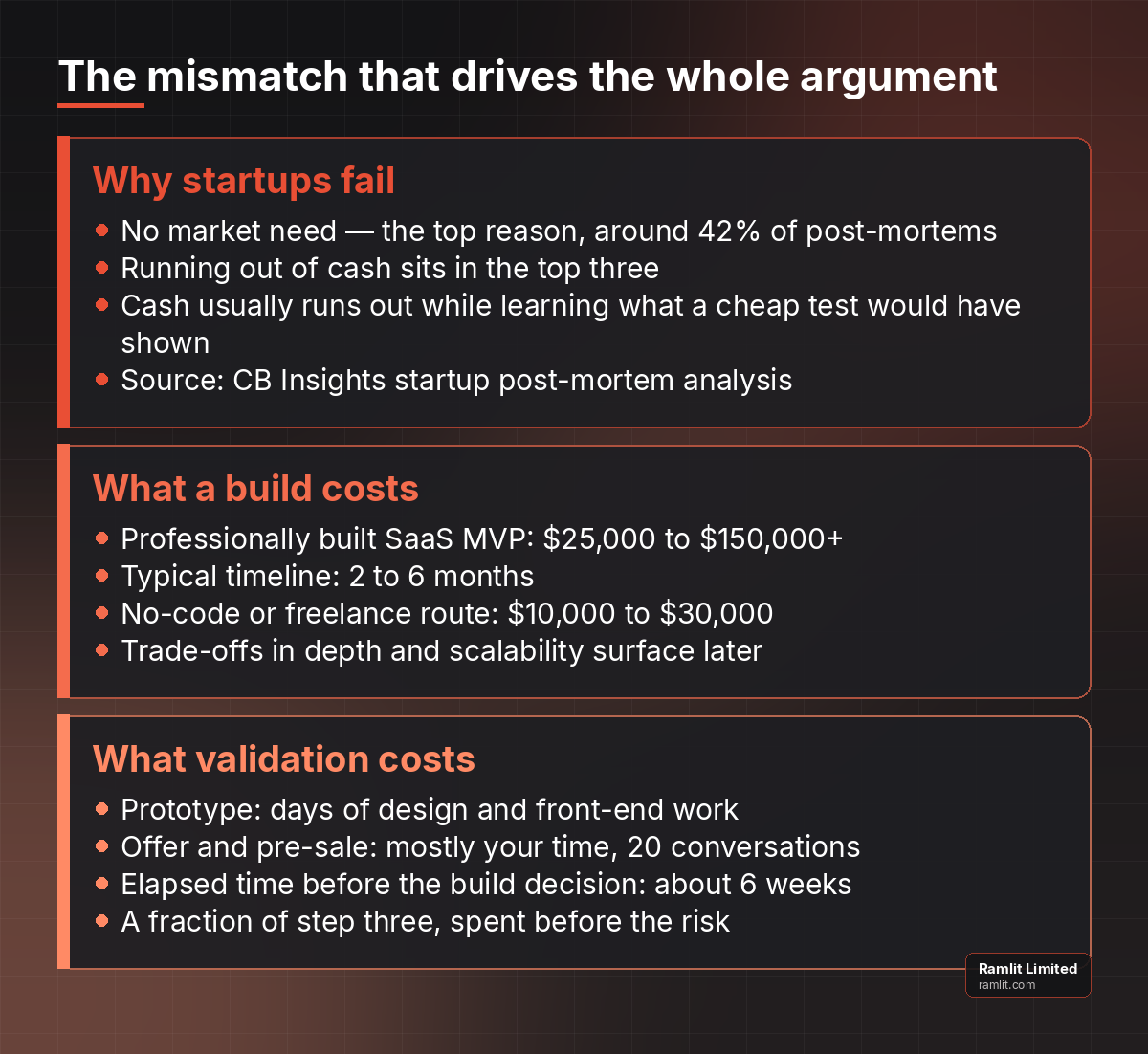 The mismatch that drives the whole argument: the biggest spend in the process happens before the biggest risk is tested.
Ramlit's read on those two figures together: the industry's standard sequence puts a five-figure commitment in front of a question that a four-figure test answers. Any process that reverses that order is worth a founder's attention.
What a Minimum Viable Offer Actually Is
The minimum viable offer is the step most founders skip. Rather than building a product and hoping people buy it, you construct the smallest complete offer — what the customer gets, what it costs, when it arrives — and put it in front of real buyers to see whether they commit.
Slack is the clearest example, and its history is not the one people remember. The team was building an online game called Glitch and built an internal chat tool because email was failing them across time zones. The game failed. The chat tool, already proven inside one company, was shown to friends at other companies with a simple question attached: we built this for ourselves and it changed how we work — would you use it? The answer was yes, and that question was the offer.
Commitment is the word that carries the weight. An offer has been tested when someone does something that costs them: a deposit, a signed letter of intent, a pilot fee, a calendar slot with their team, a place on a waiting list they had to enter a card to join. Praise is not commitment. "That looks useful, send it to me when it's ready" is the single most expensive sentence in early-stage software, because founders bank it as validation.
Traditionally an MVO was a landing page or a demo video. Both still work, and both suffer the same weakness: people react to a description rather than to a thing. Pairing the offer with a clickable prototype fixes that, and prototypes have become dramatically cheaper to produce — a shift Ramlit covered in its guide to building AI dashboards and web apps with vibe coding.
The Three-Step Sequence Ramlit Recommends
The order matters more than any individual step.
Step one: prototype. Build something a person can click through that shows the core promise. It does not store data, it does not have accounts, and behind the screens the work may be done by a human. A prototype exists to make the idea concrete enough that feedback is about the idea rather than about the reader's imagination. Days to two weeks, not months.
Step two: the offer and the pre-sale. Package it: who it is for, what it does, what it costs, when it lands. Take it to twenty real buyers. Ask for commitment, not opinion. The output is a number — how many of twenty said yes and backed it — and that number is the decision.
Step three: the build. Only now, with a validated concept, named early users and in many cases pre-sale revenue, does custom software become the right spend. Everything learned in steps one and two goes into the specification, which is also why builds that follow this order ship faster.
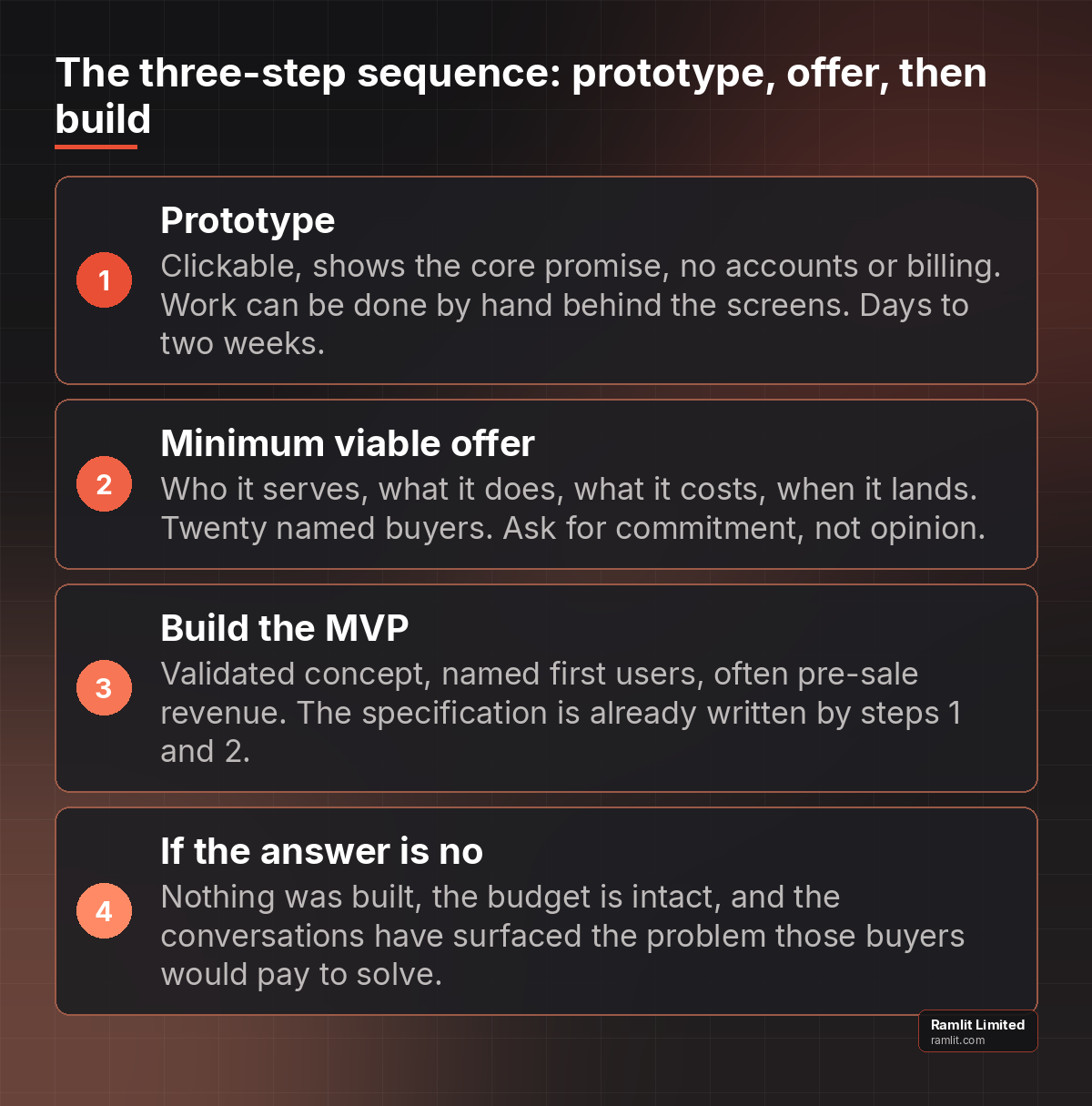 Each step costs an order of magnitude more than the one before it. Each also removes the risk that makes the next step worth funding.
One caution deserves emphasis, because it catches technically-minded founders in particular. Software that solves your problem will not automatically solve everyone else's. Other businesses are structured differently, resource things differently, and carry switching costs and change-management realities that have nothing to do with product quality. A prototype in front of five other companies tests that assumption for the price of a week.
What a Good Prototype Contains, and What It Leaves Out
Prototypes fail for one of two opposite reasons: they are so rough that the viewer cannot tell what is being proposed, or so complete that they have quietly become the product.
A useful prototype shows three things. The first screen a user would see, so the promise is visible in five seconds. The single moment where the product does the thing that makes it worth paying for — the report appearing, the schedule resolving, the invoice reconciling. And the shape of the result, so the buyer can picture it inside their own week.
It deliberately leaves out accounts and permissions, billing, settings, edge cases, empty states, error handling, and anything that exists because software normally has it. Those consume most of a build budget and none of them influence whether a buyer says yes.
Behind the screens, doing the work by hand is not cheating. A recruitment tool can be a spreadsheet and a person; a monitoring service can be someone checking twice a day. Delivering the outcome manually while the buyer experiences the finished promise is the fastest way to learn what the software must actually do, and it produces something rarer than an opinion: a customer who has received the result.
Ramlit's engineering team treats every prototype as disposable by design. Building it to be thrown away keeps it fast to change during the conversations that follow, and prevents the most common trap in this process, where a demo hardens into an unmaintainable production system because it was easier to keep going than to start properly.
How to Run the Twenty Conversations
The offer test is a sales exercise, not a research exercise, and that distinction changes everything about how it is run.
Pick twenty specific people, not a segment. "Operations managers at mid-sized logistics firms" is a segment. Twenty named people at twenty named companies is a test. If the list cannot be built, that is itself a finding about how reachable this market is.
Lead with the problem, not the product. Open by describing the situation you believe they are in and let them correct you. A buyer who spends five minutes explaining why your description is slightly wrong has just handed over the specification.
Show the prototype, then stop talking. Watch where they hesitate and what they reach for. Silence during a demo is data.
Make the ask concrete. A price, a start date, and a next step that costs something: a deposit, a pilot agreement, a scheduled session with their team. The purpose is to convert interest into commitment while the interest is in the room.
Record the outcome in one line each. Yes with money, yes with a diary commitment, interested but blocked by something specific, or no. Ambiguity gets recorded as no. Founders who allow a soft yes into the tally are the founders who build for a market that never buys.
Twenty conversations usually take two to three weeks around other work. The result is a ratio and a reason, and the reason matters more. Five yeses out of twenty with the same blocker named by the other fifteen is a stronger position than ten vague positives, because the blocker is the roadmap.
If the answer is no, the process has done its job. Nothing has been built, the budget is intact, and the twenty conversations have almost certainly surfaced a different problem those same buyers would pay to solve.
When Building First Is the Right Call
Ramlit does not apply this sequence to every engagement, and a guide that pretended otherwise would be selling a formula rather than judgment. Four situations justify going straight to a build.
Deep domain insider knowledge. A founder who has run the operation for a decade, feels the pain daily, and can name twenty people with the same problem has already done the validation, informally but genuinely.
A pre-existing internal tool. If a team has been using something internally for a year, usage data has replaced the offer test. That was Slack's position.
A signed customer. A contract, a purchase order, or a funded pilot from a named client is the strongest possible offer validation. Build it.
A compliance or replacement deadline. When an existing system is being retired, or a regulation requires a capability by a fixed date, demand is not the open question. Delivery is.
Outside those four, the burden of proof sits with the person who wants to skip to code.
What Each Step Costs, Honestly
Founders ask for numbers, so here is the shape of the spend rather than a quotation.
A prototype is measured in days of design and front-end work. A minimum viable offer costs mostly time — writing the offer, building a simple page, and the twenty conversations, which is the part nobody can outsource. A production MVP sits in the market range quoted above, $25,000 upward, over two to six months.
Two consequences follow. The first is that steps one and two together typically cost a small fraction of step three, which means running them is cheap insurance on the large decision. The second is that a founder who runs them arrives at the build with a written specification, a customer list, and often revenue — which shortens the build itself, because the expensive part of any software project is deciding what it should do while people are already building it.
What This Looks Like on a Calendar
Founders underestimate how short the whole sequence is, which is part of why they skip it. Written against a calendar it takes about six weeks before a build decision, and most of that is other people's diaries rather than work.
Week one is the offer itself: who it serves, the outcome, the price, the delivery date. Writing a price down is the step founders resist hardest and the one that forces every vague assumption into the open.
Weeks one and two run the prototype in parallel, because the offer defines what the prototype has to show. Weeks three to five are the conversations, spread around normal work at four or five a week. Week six is the decision: count the commitments, read the blockers, and either specify the build or run a second round with a revised offer.
Six weeks against a build that costs two to six months and five figures is the trade being made. Founders who have raised money sometimes object that investors expect to see product, not conversations. In practice a pre-sale list is a stronger fundraising asset than a half-built product, because it evidences demand rather than effort.
What to Ask an Agency That Wants to Start Coding
A development partner's incentives and a founder's incentives diverge at exactly this point: the agency is paid to build. Five questions surface whether the partner in front of you is thinking about your outcome.
- What evidence would convince you that we should not build this yet?
- Can you deliver a clickable prototype before any production work starts, and what does that cost on its own?
- What is the smallest version of this that could ship, and what did you cut to get there?
- If our pre-sale test fails, what do we do with what we have already paid for?
- Who owns the prototype, the designs and the code at each stage?
A partner who cannot answer question one has no opinion about your business, only about your budget. For teams that need this implemented and maintained by an expert team, Ramlit handles exactly this — ramlit.com/services.
Five Signals You Are Ready to Build
Founders want a line rather than a philosophy, so here is the line Ramlit uses in scoping calls. Three or more of these, and the build is justified.
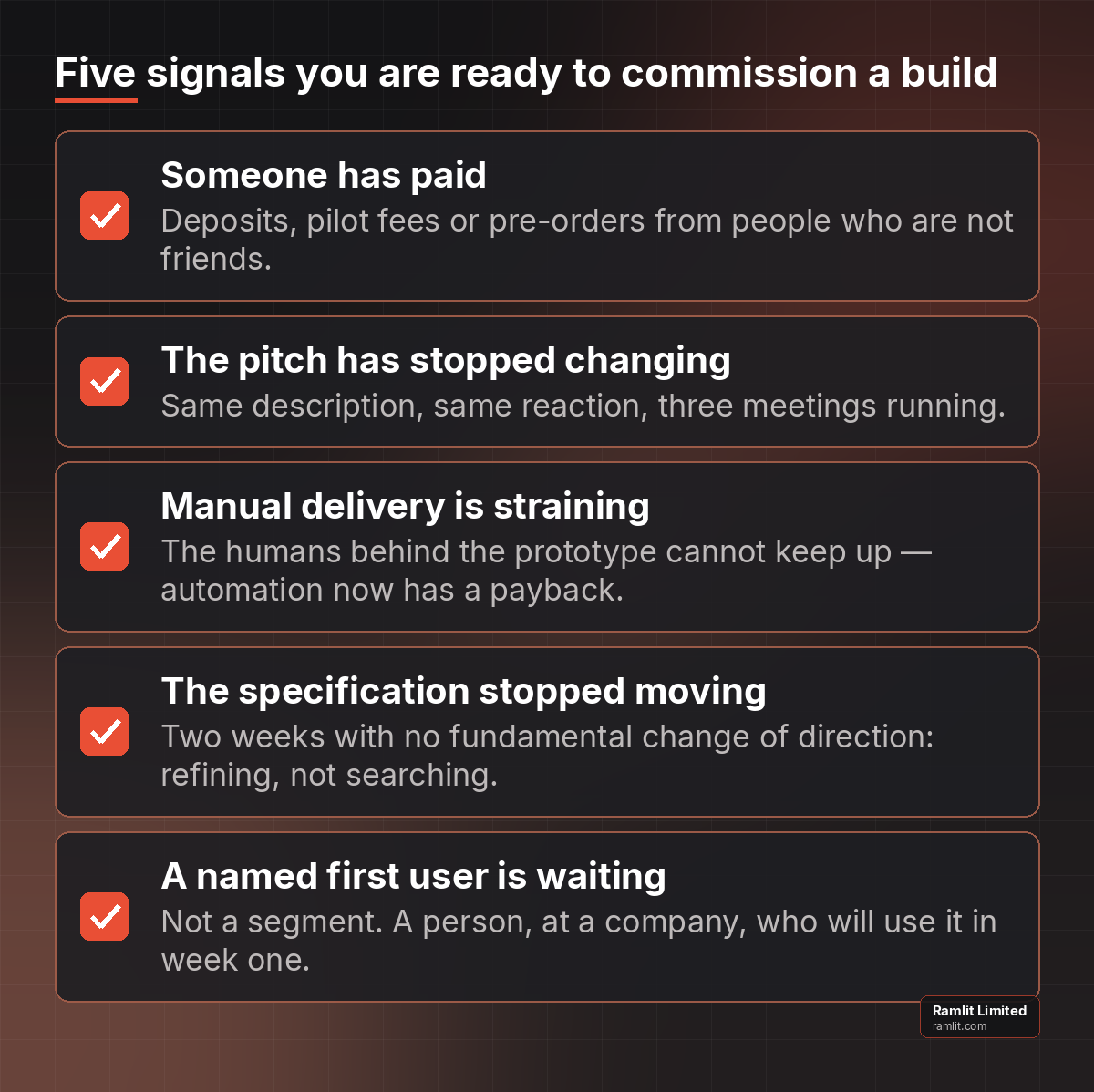 Three or more and the spend is evidence-backed. Fewer, and another two weeks of validation is the cheaper move.
Someone has paid. Deposits, pilot fees or pre-orders from people who are not friends.
The pitch has stopped changing. When the same description of the product produces the same reaction three meetings running, the concept has stabilised enough to specify.
Manual delivery is straining. If the service is being delivered by hand behind a prototype and the humans cannot keep up, automation has a measurable payback.
The specification stopped moving. Two weeks without a fundamental change of direction means you are refining rather than searching.
A named first user is waiting. Not a market segment — a person, at a company, who has agreed to use it in week one.
Teams that reach that point tend to have already automated the manual parts of their delivery, which is where Ramlit's work on AI agent development for business automation usually begins.
Frequently Asked Questions
What is a minimum viable offer in simple terms?
A minimum viable offer is a complete, specific promise — what the customer gets, at what price, by when — presented to real buyers before the product is built, to see whether they will commit. It replaces "would you use this?" with "will you pay for this?", which is the only question that predicts revenue.
How is an MVO different from an MVP?
An MVP is a working product, stripped to its core features, that customers can use. An MVO is the offer for that product, tested before it exists. The MVO answers whether demand is real; the MVP answers whether the solution works. Running them in that order means the expensive step is funded by evidence.
Does this apply to non-software businesses?
Yes. A service business can sell a package before hiring the team to deliver it, an agency can pre-sell a retainer before building the process, and a product company can take deposits before a manufacturing run. The principle is identical: test the promise before you buy the capacity.
How many customers do I need before building?
There is no universal number, and anyone who quotes one is guessing. A practical threshold for business software is a handful of paid commitments plus one named first user who has agreed to go live. For lower-priced consumer products the equivalent is a waiting list large enough that the conversion rates you assume still produce a viable business.
Will an agency really tell me not to build?
A good one will, because a project built on unvalidated demand fails publicly and the agency's name is attached to it. Ask question one from the list above during your first call. The answer tells you which kind of partner you are talking to.
Ready to Build Your Solution?
Ramlit Limited delivers smart, secure, and scalable tech solutions for businesses worldwide.
- Get a Free Quote: ramlit.com/contact
- Email: info@ramlit.com
- Phone: +880 1723-741224
- Explore Services: ramlit.com/services
Part of the Mejba Ahmed brand family: mejba.me · colorpark.io · xcybersecurity.io