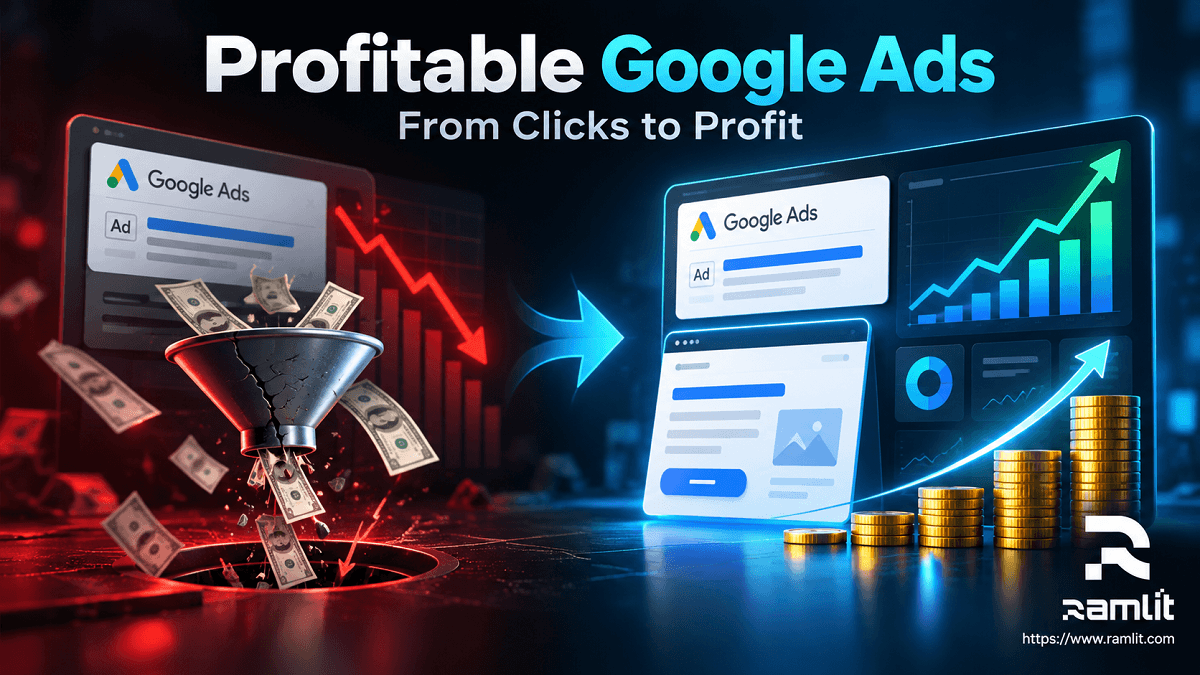

Why Google Ads Campaigns Lose Money—and How to Build Profitable Campaigns
A Google Ads campaign can generate clicks, conversions, and even an impressive-looking ROAS while still being a poor business investment.
That happens because advertising performance does not end when somebody clicks an ad.
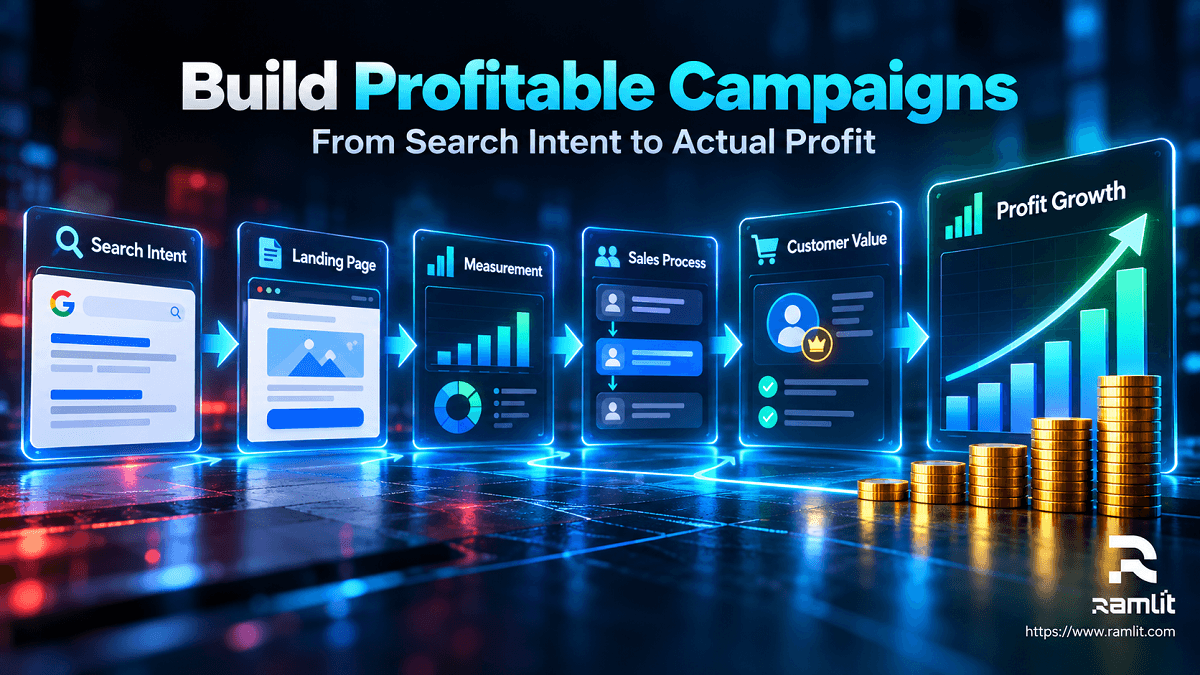
The complete system looks more like this:
Search intent
    ↓
Keyword / targeting
    ↓
Ad
    ↓
Landing page
    ↓
Offer
    ↓
Conversion
    ↓
Sales process
    ↓
Repeat purchases
    ↓
Actual profit
If any important part of that chain is weak, buying more traffic can simply make the business lose money faster.
This is why profitable Google Ads campaigns require more than keyword research, compelling ad copy, or automated bidding.
You need to understand:
- What one customer is actually worth
- How much you can afford to acquire that customer
- Whether the landing page matches the intent that generated the click
- Which conversions should influence Google's bidding system
- What happens to leads after they submit a form
- Whether attributed revenue represents incremental business
- How much revenue remains after product and fulfillment costs
The objective is not to maximize clicks.
It is not even necessarily to maximize conversions.
The objective is to acquire valuable customers at an economically sustainable cost.
Google Ads Does Not Create Profit by Itself
Google Ads can help businesses reach people who are actively searching for products, services, or solutions.
But the advertising platform controls only part of the customer journey.
Consider two companies bidding on the same search query.
Both pay:
$5 per click
Both attract:
1,000 clicks
Advertising cost:
$5,000
Company A converts 20 customers.
Its acquisition cost is:
$5,000 ÷ 20 = $250 CAC
Company B converts 50 customers.
Its acquisition cost is:
$5,000 ÷ 50 = $100 CAC
The traffic cost was identical.
The economics were not.
That difference may come from:
- Landing-page relevance
- Offer quality
- Trust
- Checkout friction
- Lead qualification
- Sales follow-up
- Pricing
- Customer intent
- Mobile usability
- Payment experience
This is why Google itself includes landing-page experience as one of the components used to diagnose ad quality. Google recommends keeping the message consistent between the search, ad, and landing page and ensuring that the destination is relevant and useful to the visitor.
Start With Unit Economics, Not Campaign Settings
Before choosing a bidding strategy or daily budget, determine how much a conversion is worth.
This is where many campaign discussions become misleading.
Suppose an ecommerce store sells a product for:
Revenue: $100
But the business also pays:
Product cost:       $35
Fulfillment:        $10
Payment fees:        $3
Variable support:    $2
-----------------------
Variable costs:     $50
Contribution before advertising:
$100 - $50 = $50
The business cannot sustainably spend $80 acquiring that order simply because the campaign generated $100 in revenue.
At an $80 customer acquisition cost:
$50 contribution - $80 advertising = -$30
The campaign loses money.
Calculate Your Break-Even ROAS
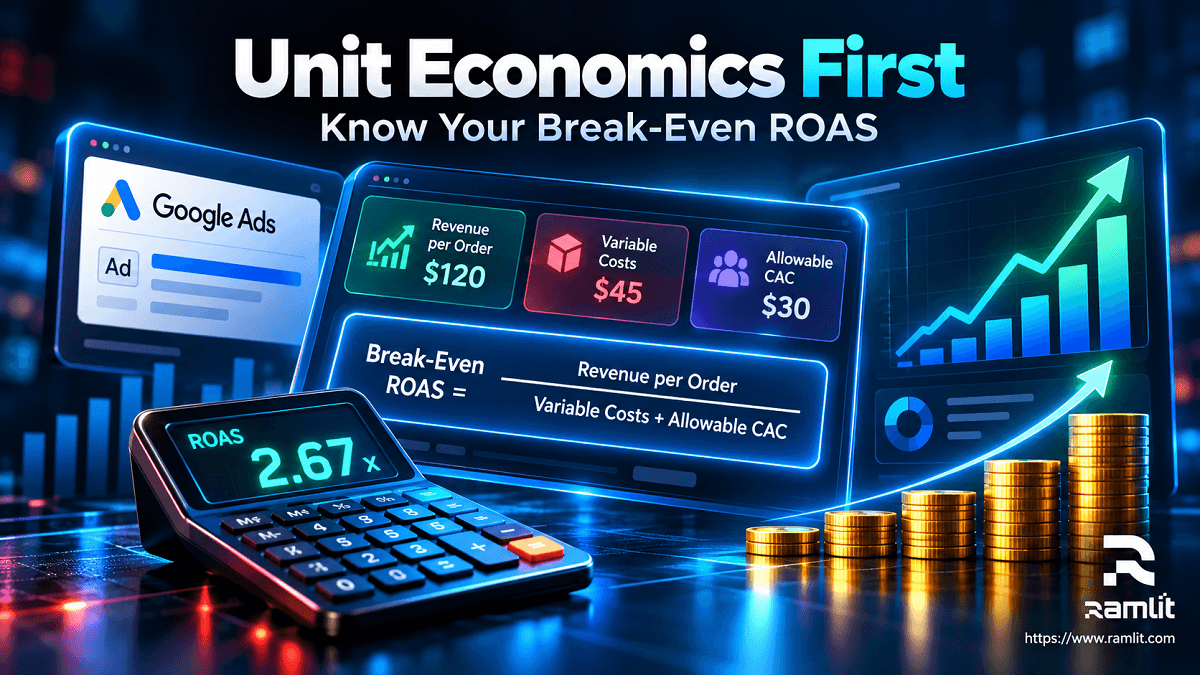
A useful simplified formula is:
Break-even ROAS =
Revenue ÷ Maximum Affordable Ad Spend
If a $100 sale produces $40 in contribution margin before advertising:
Break-even ROAS =
$100 ÷ $40
= 2.5
= 250%
At roughly 250% ROAS, advertising consumes the entire $40 contribution in this simplified example.
Anything below that is unprofitable unless downstream customer value compensates for the difference.
Anything above it creates contribution after advertising.
This immediately demonstrates why a universal claim such as:
"A 3x ROAS is good."
is meaningless without knowing the business economics.
A 300% ROAS might be excellent for one company and unprofitable for another.
Revenue ROAS Is Not the Same as Profit
Google Ads commonly reports conversion value and ROAS.
Those metrics are valuable.
But businesses should also calculate performance from their own financial data.
A more useful internal view may include:
Revenue
- Cost of goods/services
- Fulfillment
- Payment fees
- Refunds
- Discounts
- Variable service costs
- Advertising cost
-------------------------
Contribution after ads
For service businesses, substitute the relevant delivery costs.
This is especially important when different products have dramatically different margins.
A campaign generating $100,000 in low-margin revenue may be less valuable than another campaign generating $60,000 from high-margin products.
Google Ads supports assigning conversion values and using value-based bidding so campaigns can optimize toward business value rather than simply counting every conversion equally.
Why the Post-Click Experience Matters So Much
An ad creates an expectation.
The landing page has to fulfill it.
Suppose somebody searches:
emergency roof repair london
and clicks an ad promising:
24-Hour Emergency Roof Repair
But the destination is a generic construction-company homepage with:
- Multiple unrelated services
- No emergency-service information
- No location confirmation
- No clear phone number
- No proof of availability
- No obvious next step
The keyword may be correct.
The ad may be excellent.
The bid may be competitive.
The page still creates friction.
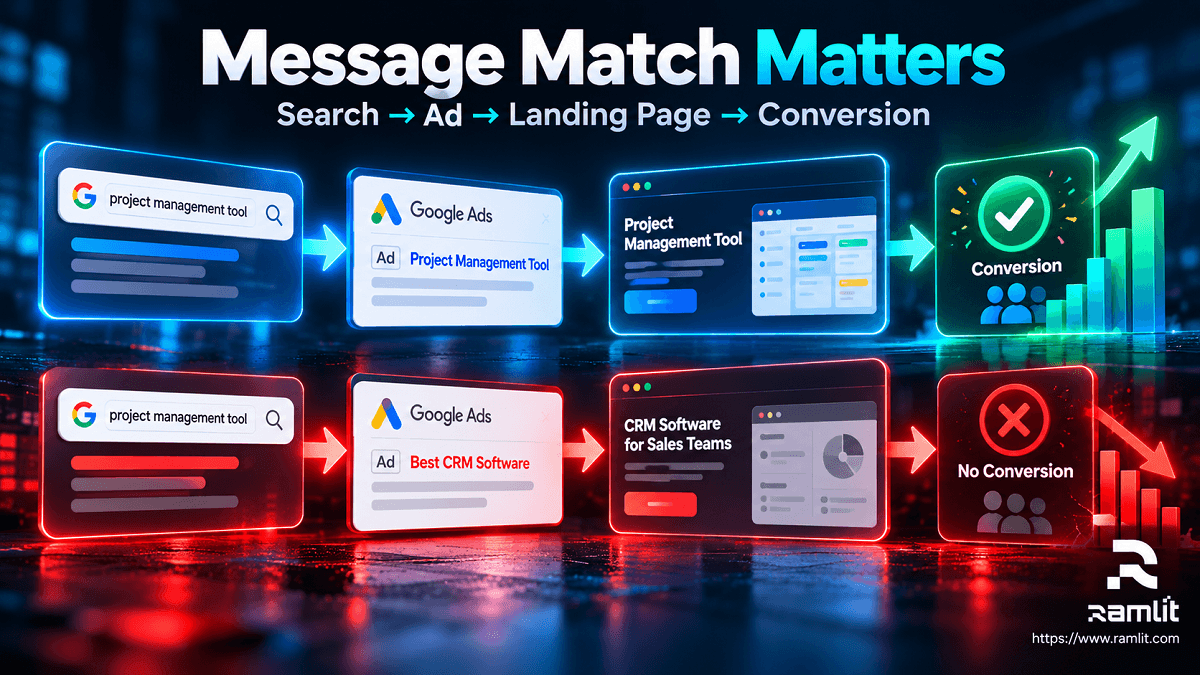
A more aligned journey would be:
Search:
Emergency roof repair London

↓

Ad:
Emergency Roof Repair in London
24/7 Callout

↓

Landing Page:
Emergency Roof Repair
Serving London
Call Now / Request Assistance
This is message match.
The closer the search intent, advertisement, offer, and landing page align, the easier it is for the visitor to understand that they have reached the right destination.
Build Landing Pages Around Intent, Not Traffic Volume
A landing page should answer several questions quickly:
- Am I in the right place?
- Does this solve my problem?
- Is this relevant to me?
- Why should I trust this company?
- What does it cost or what happens next?
- What should I do now?
The exact structure depends on the product and buying decision.
A high-intent ecommerce page may emphasize:
- Product
- Price
- Delivery
- Reviews
- Returns
- Payment options
- Purchase CTA
A B2B software page may need:
- Outcome
- Use cases
- Product demonstration
- Integrations
- Customer evidence
- Security information
- Demo CTA
A high-ticket service may require:
- Problem definition
- Methodology
- Portfolio or case studies
- Qualifications
- Process
- FAQs
- Consultation CTA
There is no universally correct landing-page length.
Use enough information to resolve the objections relevant to that purchase.
The Ad-to-Landing-Page Continuity Test
For each major campaign, compare these four elements side by side:
| Stage | Question |
|---|---|
| Search | What does the user actually want? |
| Keyword/audience | Are we attracting that intent? |
| Ad | What promise are we making? |
| Landing page | Does the page immediately continue that promise? |
If these stages tell different stories, fix the disconnect before increasing spend.
Google explicitly recommends aligning the landing page with user searches and keeping messaging consistent from the ad to the landing page.
Conversion Rate Alone Can Mislead You
Imagine Campaign A converts at:
8%
Campaign B converts at:
4%
Campaign A appears superior.
But suppose Campaign A generates low-quality leads and only 5% become customers.
Campaign B attracts better-qualified prospects and 30% close.
The lower website conversion rate may produce significantly more revenue.
For lead-generation campaigns, the funnel should therefore be measured beyond the form submission:
Click
 ↓
Lead
 ↓
Qualified Lead
 ↓
Opportunity
 ↓
Customer
 ↓
Revenue
 ↓
Contribution
Optimizing solely for the cheapest lead can teach an automated bidding system to find more people who submit forms—not necessarily more people who become profitable customers.
Connect Offline Sales Back to Google Ads
This is particularly important for:
- B2B sales
- Agencies
- Professional services
- High-ticket products
- Phone-based sales
- Dealerships
- Businesses using CRMs
If Google only sees:
Form submitted = conversion
it cannot distinguish a valuable opportunity from a poor-quality lead.
A stronger setup can return downstream events such as:
Lead created
      ↓
Qualified lead
      ↓
Sales opportunity
      ↓
Closed customer
      ↓
Actual conversion value
Google's enhanced conversions for leads are designed to improve measurement by connecting first-party lead information with downstream conversion data. In 2026, Google also changed this infrastructure: enhanced conversions for web and leads were unified, and Google shifted current offline-conversion workflows toward Data Manager.
For businesses running serious lead-generation campaigns, CRM-to-ad-platform measurement is increasingly part of the advertising architecture rather than an optional reporting enhancement.
Improve Conversion Measurement Before Scaling Spend
Automated bidding depends on the signals you give it.
Bad measurement creates bad optimization.
Before scaling, audit:
- Purchase tracking
- Revenue values
- Lead tracking
- Duplicate conversions
- Phone conversions
- CRM events
- Enhanced conversions
- Consent implementation
- Attribution settings
Google's enhanced conversions supplement normal conversion tracking with hashed first-party customer information to improve measurement accuracy.
For businesses operating where user consent requirements apply, Google Consent Mode can communicate consent choices to Google tags while working with an existing consent mechanism.
Tracking architecture should be treated as infrastructure.
You should not confidently optimize a campaign if you do not trust its conversion data.
Stop Treating Every Conversion as Equally Valuable
Consider a software company with three conversions:
Newsletter signup:       $?
Free trial:               $?
Paid subscription:      $500 expected value
If every event is configured as an equally important primary conversion, an automated system can optimize toward the easiest action.
That may create excellent-looking conversion counts and weak business performance.
Instead, align conversion values and optimization goals with actual business outcomes.
Google's current guidance on conversion values specifically encourages advertisers to assign values that better represent business impact and use appropriate value-based bidding when suitable.
Target ROAS Is Only as Good as the Value Data
Target ROAS bidding attempts to maximize conversion value while working toward an advertiser's return target.
Google uses reported conversion values to help predict the potential value of future conversions and adjust bids accordingly.
That creates an important dependency:
Poor value data
      ↓
Poor optimization signal
      ↓
Automated bidding optimizes toward the wrong economics
Before relying heavily on value-based bidding, confirm that conversion values represent the outcomes the business actually cares about.
Also note a 2026 interface change: Google reorganized how some Smart Bidding strategies are labeled beginning in June 2026. The underlying bidding behavior did not fundamentally change simply because labels changed.
Build a Funnel for Buyers Who Are Not Ready Yet
Not every qualified visitor will convert on the first visit.
That is particularly true for:
- Expensive products
- B2B services
- Complex software
- Financial decisions
- Education
- Consulting
- Long-consideration purchases
Forcing every visitor toward the final transaction can waste valuable demand.
An appropriate funnel might offer:
Google Ad
   ↓
Landing Page
   ↓
Primary conversion
OR
Useful secondary action
   ↓
Email / CRM follow-up
   ↓
Remarketing where appropriate
   ↓
Sales conversation
   ↓
Customer
Possible secondary actions include:
- Demo
- Quote
- Product comparison
- Calculator
- Consultation
- Trial
- Guide
- Saved cart
The lead magnet should have genuine value and a logical relationship to the eventual purchase.
Collecting email addresses purely to increase a marketing database is not the goal.
Email Follow-Up Should Continue the Buying Journey
A visitor who leaves without purchasing may still have genuine intent.
Follow-up can address the reasons they hesitated.
For example:
Email 1:
Deliver requested resource or confirmation

Email 2:
Explain the main problem

Email 3:
Show how the solution works

Email 4:
Address a common objection

Email 5:
Provide proof or a practical example

Email 6:
Invite the prospect to the appropriate next step
The sequence should reflect the actual buying process.
Avoid arbitrary claims about customers requiring a fixed number of "touches." Purchase behavior varies widely by category, price, urgency, audience, and brand familiarity.
Reduce Checkout Friction
For ecommerce campaigns, acquisition economics can be lost during checkout.
Audit:
- Guest checkout
- Mobile usability
- Form complexity
- Unexpected shipping fees
- Delivery information
- Payment failures
- Coupon distractions
- Account-creation requirements
- Error messages
- Payment options
Alternative payment methods can be worth testing when they match the target audience.
But do not assume simply adding a payment logo will produce a universal percentage increase in conversions.
Test the effect using your own customers.
Multi-Step Checkout: Test It, Don't Assume It
Breaking a long process into several steps can sometimes make complicated forms easier to understand.
For example:
Step 1: Contact details

Step 2: Delivery

Step 3: Payment

Step 4: Review
But multi-step design is not inherently superior.
Additional steps can also create more exit points.
The correct design depends on:
- Number of required fields
- Device
- Purchase complexity
- Customer expectations
- Existing account information
- Performance
Treat checkout structure as an experiment rather than a psychological rule.
Use Social Proof Carefully
Evidence can reduce uncertainty.
Useful proof may include:
- Verified customer reviews
- Detailed case studies
- Real customer examples
- Certifications
- Relevant client logos used with permission
- Product ratings
- Independent reviews
- Demonstrations
Weak social proof includes:
"Thousands of customers love us."
with no verifiable evidence.
Trust is not created by placing a testimonial section on a page.
It comes from credible evidence.
Never manufacture testimonials, review counts, customer names, results, or endorsements.
Personalize Where Differences Actually Matter
Sending everybody to the same landing page can be inefficient when search intent differs substantially.
Consider an accounting platform serving:
Freelancers
Ecommerce companies
Agencies
Construction firms
The underlying software may be identical.
But each audience cares about different outcomes.
A freelancer may care about:
- Invoicing
- Expenses
- Taxes
An ecommerce company may care about:
- Payment reconciliation
- Inventory integrations
- Multi-channel revenue
Instead of superficial personalization such as changing only the headline, build pages around meaningful use cases.
That produces relevance without pretending each visitor needs a completely different product.
Remarketing Should Reflect User Behavior
Someone who read a blog article is not equivalent to somebody who:
- Visited pricing
- Started checkout
- Requested a quote
- Viewed the same product repeatedly
- Abandoned a cart
Remarketing strategy should reflect those differences.
A simplified segmentation model could be:
Educational visitor
→ More education

Product visitor
→ Product benefits / comparison

Pricing visitor
→ Objection handling

Cart abandoner
→ Return to checkout

Existing customer
→ Cross-sell or retention campaign
This is more useful than showing the same generic advertisement to every previous visitor.
Apply appropriate consent, privacy, and advertising-platform policies when building remarketing audiences.
Increase Customer Value Before Increasing CPC
One of the most powerful improvements to advertising economics happens after the initial conversion.
Suppose two competitors acquire customers at:
$80 CAC
Company A earns:
$100 contribution per customer
Company B earns:
$250 contribution over a realistically measured customer relationship
Company B has far more room to compete for valuable traffic.
Ways customer value may increase include:
- Relevant upsells
- Cross-sells
- Subscriptions
- Repeat purchase
- Better retention
- Bundling
- Higher-margin product mix
The objective is not to manipulate customers into buying unnecessary products.
It is to make relevant additional value available when it genuinely helps them.
Be Careful With Customer Lifetime Value
Lifetime value is useful.
It can also justify bad campaigns when calculated too optimistically.
Suppose your initial sale is unprofitable and your spreadsheet assumes the customer will purchase repeatedly for five years.
That assumption should not become permission to overspend today.
Prefer:
Observed retention
Observed repeat purchase behavior
Observed margins
Observed cohort performance
over optimistic projections.
If your data reliably shows that certain new customers create additional future value, Google Ads also provides lifecycle-oriented features that allow advertisers to represent additional new-customer value in campaign optimization.
Last-Click Attribution Does Not Tell the Whole Story
Consider this journey:
Generic search ad
      ↓
Website visit
      ↓
User leaves
      ↓
Sees another campaign
      ↓
Returns later
      ↓
Searches company name
      ↓
Purchases
Giving all credit to the final branded search can hide the role earlier advertising played.
Google Analytics currently provides attribution reporting including data-driven attribution as well as last-click approaches. Its data-driven model attempts to distribute conversion credit based on each advertiser's observed conversion paths rather than automatically assigning all value to the final interaction.
However, attribution is still not the same thing as causality.
Attribution and Incrementality Are Different
Attribution asks:
Which marketing interactions should receive credit for this conversion?
Incrementality asks:
Would this conversion have occurred if the advertising had not happened?
That distinction is critical.
A campaign can receive attribution for customers who might have purchased anyway.
Where scale and eligibility permit it, controlled lift testing can provide stronger evidence.
Google's Conversion Lift methodology compares exposed and control groups to estimate conversions caused by advertising, rather than simply conversions associated with it. Google also reports incremental metrics such as incremental conversions and incremental ROAS for supported studies.
Conversion Lift is not available to every account and currently has eligibility requirements, so it should not be presented as a universal solution.
Measure Search Demand Separately From Brand Capture
Branded search often looks extremely efficient.
That makes sense.
People searching directly for a company already know the brand.
Therefore, when evaluating growth campaigns, distinguish between:
Brand search

vs.

Non-brand search

vs.

Competitor/category demand

vs.

Remarketing
This makes it easier to understand where the campaign is:
- Capturing existing demand
- Creating new demand
- Converting returning users
- Defending branded searches
Combining everything into one account-level ROAS can hide important differences.
A Practical Google Ads Profitability Dashboard
A useful dashboard should go beyond CPC and conversions.
Consider tracking:
| Metric | What it tells you |
|---|---|
| Spend | Advertising investment |
| CPC | Cost to acquire traffic |
| Landing-page conversion rate | How effectively traffic converts |
| Cost per lead/order | Acquisition efficiency |
| Qualified lead rate | Lead quality |
| Sales close rate | Downstream sales performance |
| CAC | Customer acquisition cost |
| Revenue | Sales attributed to campaigns |
| Contribution margin | Revenue remaining after variable costs |
| ROAS | Revenue relative to advertising spend |
| Contribution after ads | Economic result after advertising |
| Repeat purchase rate | Downstream customer behavior |
| Incremental ROAS | Causal return where lift testing is available |
The correct dashboard depends on the business.
An ecommerce store and B2B consultancy should not optimize around identical KPIs.
A Practical Framework for Building More Profitable Google Ads Campaigns
Phase 1: Establish the Economics
Before changing ads, calculate:
- Average order value
- Gross or contribution margin
- Allowable CAC
- Break-even ROAS
- Refund/cancellation rate
- Lead-to-sale rate
- Customer repeat-purchase behavior
This establishes what "profitable" actually means.
Phase 2: Fix Measurement
Verify:
- Google Ads conversion tracking
- GA4 events
- Purchase values
- Primary vs secondary conversions
- Enhanced conversions
- CRM integration
- Offline outcomes
- Consent configuration
- Duplicate events
Do not scale data you cannot trust.
Phase 3: Map Intent to Landing Pages
For each major campaign:
Keyword / audience
        ↓
Intent
        ↓
Advertisement
        ↓
Landing page
        ↓
Offer
Remove unnecessary disconnects.
Phase 4: Improve the Conversion Path
Prioritize high-friction stages:
- Hero messaging
- CTA
- Form
- Product page
- Checkout
- Payment
- Mobile interface
- Lead response
- Sales follow-up
Make one meaningful change at a time when possible.
Phase 5: Send Better Value Signals
If different outcomes have different financial values, represent those differences.
For lead-generation businesses, feed qualified or closed outcomes back into the measurement system where technically appropriate.
Phase 6: Increase Customer Economics
Evaluate:
- Upsells
- Cross-sells
- Retention
- Subscription
- Higher-margin products
- Better qualification
The stronger the customer economics, the more aggressively a business can compete for profitable demand.
Phase 7: Scale Gradually
Increase spend when:
- Tracking is reliable
- Conversion quality is stable
- Unit economics work
- Sales operations can handle volume
- Inventory/capacity can support demand
- Marginal performance remains acceptable
A campaign that works at $100 per day will not automatically maintain identical economics at $10,000 per day.
Scaling changes the auction opportunities available to the system.
How to Diagnose an Unprofitable Campaign
Use this order rather than changing everything simultaneously.
Problem 1: Too Few Relevant Clicks
Investigate:
- Search intent
- Keywords
- Search terms
- Audience
- Geography
- Ad relevance
Problem 2: Good Traffic, Poor Conversion
Investigate:
- Landing-page message match
- Offer
- Page usability
- Trust
- Mobile experience
- Form
- Checkout
Problem 3: Many Leads, Few Customers
Investigate:
- Lead qualification
- Conversion definition
- Sales response speed
- Sales process
- Targeting
- CRM feedback loop
Problem 4: Good Sales, No Profit
Investigate:
- Contribution margin
- CAC
- Discounts
- Refunds
- Fulfillment cost
- Product mix
Problem 5: Platform Reports Look Good, Finance Disagrees
Investigate:
- Attribution
- Duplicate conversions
- Conversion values
- Brand traffic
- Offline sales imports
- Refund handling
- Incrementality
- LTV assumptions
This diagnostic sequence prevents the common mistake of changing keywords when the real problem is checkout—or rebuilding the landing page when the real problem is product economics.
Common Google Ads Profitability Mistakes
Optimizing for Clicks Instead of Business Outcomes
Traffic is a cost until it creates meaningful value.
Sending Every Campaign to the Homepage
A homepage usually serves many audiences.
High-intent ads often benefit from a more focused destination.
Treating All Leads as Conversions of Equal Quality
Connect downstream business outcomes whenever possible.
Trusting ROAS Without Checking Margin
Revenue is not profit.
Increasing Spend Before Fixing Measurement
Automated bidding cannot compensate for unreliable conversion signals.
Making Multiple Changes at Once
You may improve performance without learning why.
Using Generic Industry Benchmarks as Targets
Your:
- Margins
- Market
- Brand
- Customer value
- Sales cycle
- Geography
matter more than somebody else's average conversion rate.
Assuming Automation Removes the Need for Strategy
Google's bidding systems can automate auction decisions.
They cannot define your business economics, fix a weak offer, establish the correct conversion hierarchy, or decide which customer outcomes actually matter.
Frequently Asked Questions
Why is my Google Ads campaign getting clicks but no sales?
Possible causes include poor intent targeting, weak message match, landing-page friction, an unattractive offer, trust issues, technical problems, pricing, or checkout friction.
Start by reviewing actual search terms and then follow the complete journey from ad to conversion.
What is a good ROAS for Google Ads?
There is no universal good ROAS.
Calculate your break-even ROAS from your own margin structure and required profitability.
A 200% ROAS can be profitable for one company and disastrous for another.
Should Google Ads traffic go to a homepage or landing page?
Use the destination that best satisfies the searcher's intent.
For focused campaigns, dedicated landing pages often make it easier to maintain message and offer continuity.
Google itself treats landing-page relevance and usefulness as part of the overall advertising experience.
Should I use Target ROAS?
Target ROAS can be useful when conversion values are reliable and there is enough useful historical information for optimization.
Do not treat it as a fix for poor tracking or bad economics.
What are enhanced conversions?
Enhanced conversions supplement standard Google Ads conversion tracking with hashed first-party customer data to help improve measurement accuracy. Google made notable implementation changes to enhanced conversions during 2026, including unifying web and lead configurations.
Is last-click attribution bad?
It is not necessarily "bad," but it answers a narrow question by assigning conversion credit to the final qualifying interaction.
Longer customer journeys may require broader attribution analysis.
Where true causal measurement is important and technically feasible, incrementality experiments can provide an additional perspective.
Should I optimize for leads or sales?
If the business ultimately needs sales, optimize the system toward the strongest reliable downstream signal you can measure at sufficient volume.
For some businesses that may initially be a lead.
For more mature measurement setups, it may be qualified leads, opportunities, purchases, or conversion value.
Profitable Google Ads Campaigns Are Systems, Not Ad Groups
Advertising profitability is rarely determined by one clever headline.
It emerges from the complete system:
Correct intent
      +
Relevant ad
      +
Strong landing page
      +
Valuable offer
      +
Low-friction conversion
      +
Reliable measurement
      +
Good sales execution
      +
Healthy customer economics
      =
Scalable advertising
Google Ads can bring qualified demand to your business.
It cannot repair a broken customer journey after the click.
That is why the strongest campaigns connect media buying with landing-page optimization, measurement architecture, CRM data, sales operations, customer value, and financial reality.
Before increasing your next campaign budget, audit the entire path from search query to contribution margin.
You may discover that the biggest opportunity is not inside Google Ads at all.
Ready to Build Your Solution?
Ramlit Limited delivers smart, secure, and scalable tech solutions for businesses worldwide.
- Get a Free Quote: ramlit.com/contact
- Email: info@ramlit.com
- Phone: +880 1723-741224
- Explore Services: ramlit.com/services
Part of the Mejba Ahmed brand family: mejba.me · colorpark.io · xcybersecurity.io