
How to Rank Higher on Google in 2026: A Practical SEO System for Sustainable Growth
Publishing more articles is not an SEO strategy.
Adding keywords to a page is not an SEO strategy.
Buying another SEO tool is not an SEO strategy either.
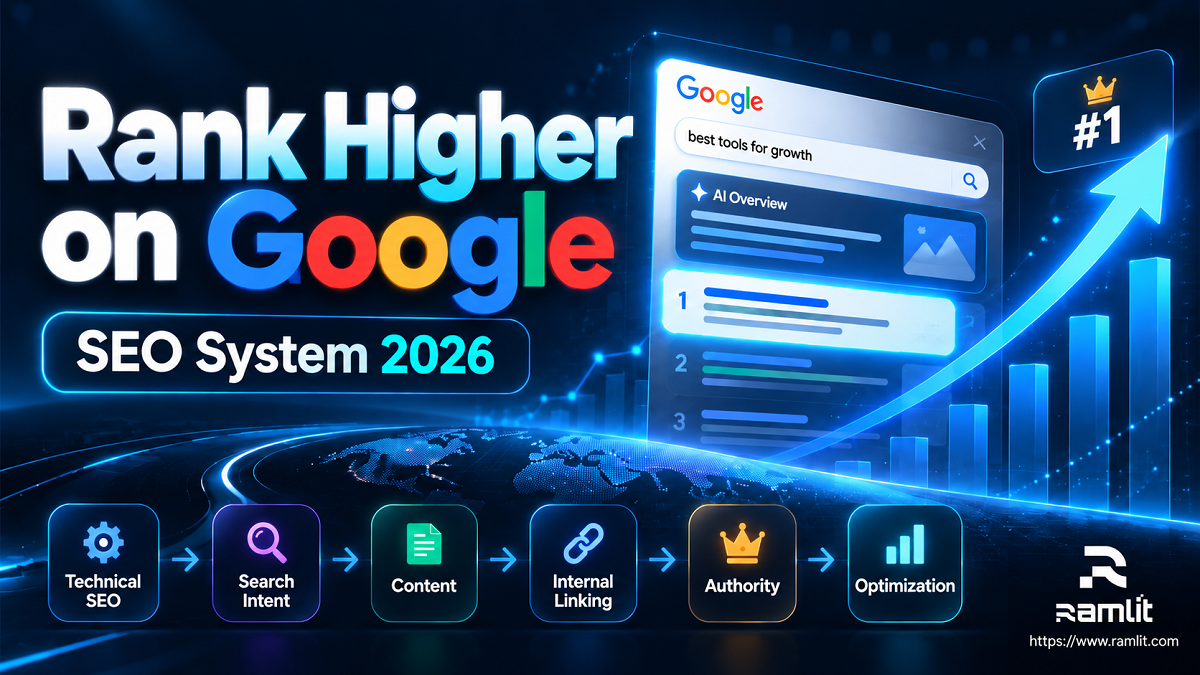
To rank higher on Google in 2026, businesses need a system that connects technical accessibility, search intent, useful content, information architecture, internal linking, authority, page experience, measurement, and ongoing maintenance.
That matters even more now that Google Search includes traditional results alongside AI Overviews, AI Mode, visual search, video results, and other search experiences.
Google's own 2026 guidance is clear on one important point: traditional SEO fundamentals still matter for generative AI search experiences because those experiences rely on Google's existing Search index, ranking systems, and quality systems. Google for Developers
The opportunity is therefore not to abandon SEO for a new acronym.
It is to build a better SEO system.
A practical model looks like this:
Technical accessibility
        ↓
Search intent
        ↓
Information architecture
        ↓
Useful, original content
        ↓
Internal linking
        ↓
Authority + discovery
        ↓
Measurement
        ↓
Content improvement
        ↺
Each layer strengthens the others.
If Google cannot reliably discover or understand a page, excellent writing may never reach its potential.
If the page is technically perfect but does not satisfy the searcher's intent, technical SEO cannot rescue it.
And if a useful page earns visibility but is never maintained as facts, competitors, and user expectations change, performance may eventually weaken.
This guide explains how to build that system in 2026.
What Changed About SEO in 2026?
SEO is not disappearing.
Search is expanding.
People can now discover information through:
- Traditional organic results
- AI Overviews
- AI Mode
- Image and multimodal search
- Video results
- Local results
- Shopping experiences
- Forums and discussions
- Discover and other Google surfaces
Google added dedicated guidance in 2026 for optimizing websites for generative AI features and explicitly states that established SEO practices remain relevant. Google for Developers
This changes the goal slightly.
The question is no longer only:
How do I rank one blue link?
A better question is:
How do I make my website technically accessible, trustworthy, useful, understandable, and valuable enough to be surfaced across modern search experiences?
The foundation remains the same.
1. Fix Technical Discoverability Before Chasing Rankings
SEO begins with a simple requirement:
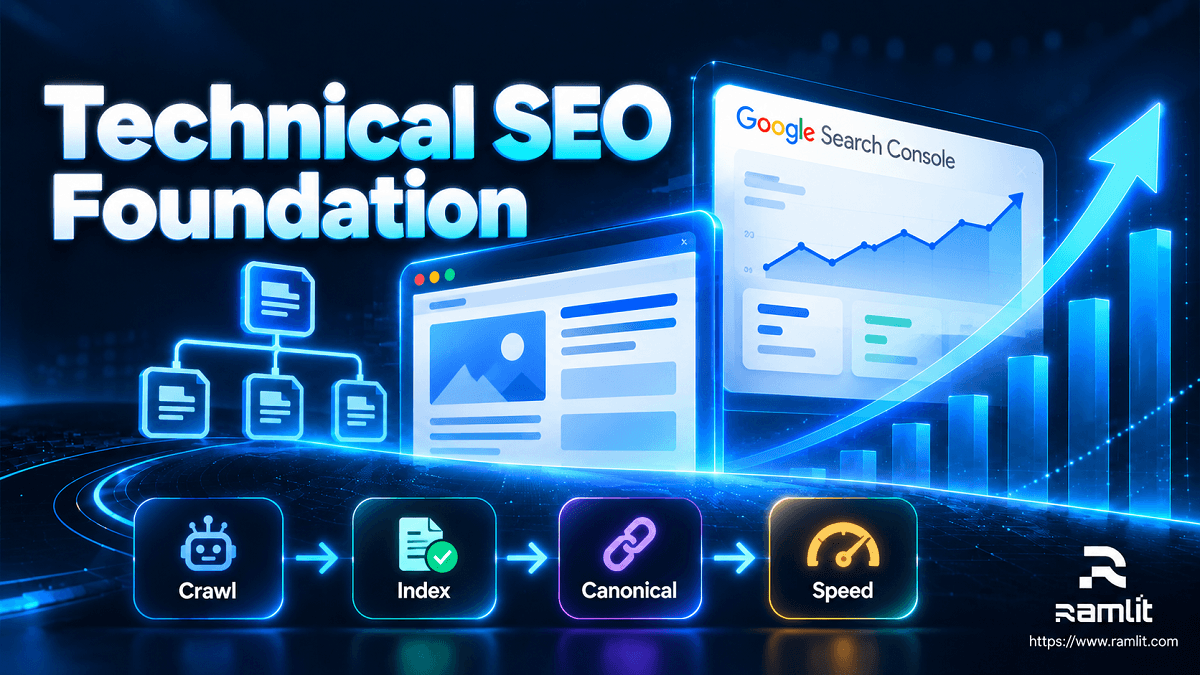
Google needs to be able to discover, crawl, render, and understand the pages you want indexed.
That sounds obvious, but technical mistakes can undermine months of content work.
Audit Crawlability
Review important URLs for:
- Incorrect
robots.txtdirectives - Accidental
noindex - Broken internal links
- Redirect loops
- Long redirect chains
- Server errors
- Soft 404s
- Orphaned pages
- Sitemap problems
- Incorrect canonical tags
One important distinction is often misunderstood.
robots.txt primarily controls crawling. It is not the correct method for guaranteeing that a web page stays out of Google Search.
Google specifically recommends noindex, password protection, or removing the content when the objective is preventing indexing. Google for Developers
Check Indexing With Search Console
Google Search Console should be one of your primary diagnostic tools.
For important pages, inspect:
URL
 ↓
Can Google crawl it?
 ↓
Is indexing allowed?
 ↓
Which canonical did Google select?
 ↓
Was the page indexed?
 ↓
Does it receive impressions?
Do not assume:
Published = indexed.
Those are different states.
Get Canonicalization Right
Duplicate URLs can exist for perfectly normal reasons:
/products/shoes
/products/shoes?sort=price
/products/shoes?ref=email
Google uses canonicalization to choose a representative URL from similar or duplicate pages. A rel="canonical" hint can help, but Google may still choose another URL if other signals point elsewhere. Google for Developers
Keep your signals consistent:
- Internal links
- Sitemap URLs
- Canonical tags
- Redirects
- HTTPS preference
They should generally point toward the same preferred URL.
2. Improve Page Experience Without Obsessing Over Perfect Scores
Performance matters.
But SEO teams sometimes treat Lighthouse scores as if a perfect score automatically produces top rankings.
It does not.
Google's current documentation says Core Web Vitals are used by its ranking systems, but also emphasizes that page experience consists of multiple factors and that excellent scores do not guarantee high rankings. Google for Developers
The current Core Web Vitals targets include:
| Metric | Good Experience Target |
|---|---|
| Largest Contentful Paint | ≤ 2.5 seconds |
| Interaction to Next Paint | < 200 ms |
| Cumulative Layout Shift | < 0.1 |
Practical improvements may include:
- Proper image dimensions
- Modern image formats
- Responsive images
- Effective caching
- CDN delivery
- Reduced render-blocking JavaScript
- Font optimization
- Database/query improvements
- Server-side caching
- Avoiding layout shifts
- Removing unnecessary third-party scripts
The goal should be a good user experience, not a vanity performance score.
3. Build an Information Architecture Google and Humans Can Understand
A growing site can become disorganized surprisingly quickly.
You may end up with:
/blog/seo-tips
/blog/seo-guide
/blog/best-seo-strategy
/blog/how-to-do-seo
/blog/seo-strategies
If those pages answer nearly identical questions, they may compete for the same audience and become difficult to maintain.
A stronger architecture establishes clear roles.
For example:
SEO
│
├── Technical SEO
│   ├── Crawlability
│   ├── Canonicalization
│   └── Core Web Vitals
│
├── Content SEO
│   ├── Search intent
│   ├── Content briefs
│   └── Content refreshes
│
└── Authority
    ├── Digital PR
    ├── Link earning
    └── Brand distribution
This does not mean Google requires a specific "topic cluster" template.
It means your site should have a logical structure in which:
- Each important page has a clear purpose.
- Related pages link naturally.
- Visitors can move between useful resources.
- Google can understand relationships between topics.
Keep URLs Simple
Good URLs should normally be:
- Descriptive
- Stable
- Human-readable
- Free from unnecessary parameters when possible
For example:
/services/seo-audit
is easier to understand than:
/index.php?id=98374&type=service&cat=12
Do not force keywords into URLs unnaturally.
Clarity matters more.
4. Target Search Intent Before Search Volume
One of the biggest SEO mistakes is selecting topics primarily because a keyword tool reports large monthly volume.
Volume is only one consideration.
You also need to understand why someone searches the query.
Consider:
what is crm
versus:
best crm for real estate teams
versus:
hubspot pricing
These users are at different stages.
Their ideal pages should also be different.
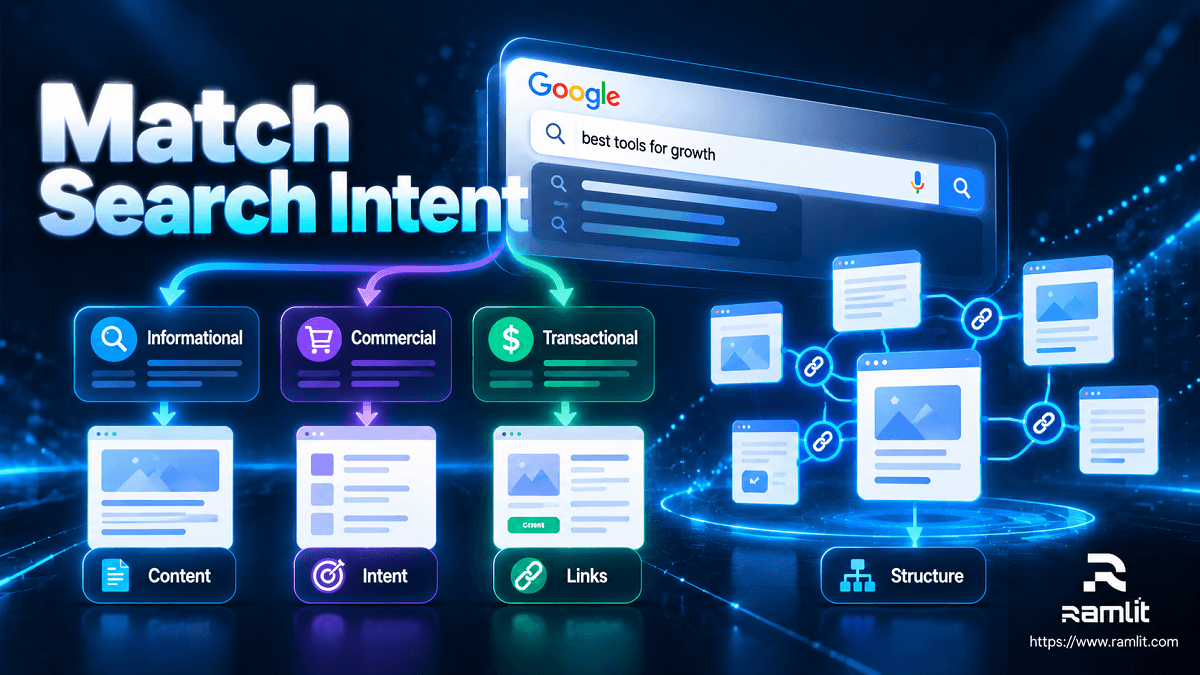
Common Intent Types
Informational
The user wants an explanation.
Example:
how does ai automation work
Suitable content:
- Guide
- Tutorial
- Explainer
Commercial Investigation
The user is comparing solutions.
Example:
best ai automation platforms for small business
Suitable content:
- Comparison
- Buyer guide
- Alternatives page
Transactional
The user is closer to taking action.
Example:
hire laravel developer
Suitable content:
- Service page
- Product page
- Pricing page
Navigational
The user wants a particular company, page, or product.
Example:
google search console login
Suitable content:
- Direct destination
Keyword Difficulty Is Not a Google Metric
SEO tools often provide a difficulty score between 0 and 100.
That score can be useful for comparison inside the same tool, but it is not a metric supplied by Google and should not be treated as an absolute threshold.
Instead of saying:
Only target keywords under difficulty 30.
Ask:
- Who currently ranks?
- What type of pages rank?
- How strong are they?
- What intent are they satisfying?
- Can my site create something meaningfully better?
- Does the topic matter to my business?
That produces better decisions than relying on one number.
5. Create People-First Content, Not Search-Engine Filler
Google's current guidance emphasizes helpful, reliable, people-first content.
It specifically warns against producing large volumes of content primarily to attract search traffic rather than helping users. Google for Developers
A useful page should leave the visitor feeling:
I understand this better now.
or:
I can take the next step.
Not:
I need to search again because this article said nothing useful.
What High-Quality Content Looks Like
Good content often contains some combination of:
- Original analysis
- Practical examples
- Real implementation details
- Useful comparisons
- Clear explanations
- Relevant screenshots
- First-party data
- Expert review
- Limitations and tradeoffs
- Helpful diagrams
- Actionable recommendations
Avoid simply rewriting the ten pages already ranking.
Google explicitly asks creators whether their content adds substantial value rather than merely copying or summarizing what other sources already say. Google for Developers
6. Understand E-E-A-T Correctly
E-E-A-T stands for:
- Experience
- Expertise
- Authoritativeness
- Trustworthiness
But there is an important nuance:
E-E-A-T itself is not one direct ranking factor.
Google says its systems use multiple signals that can identify qualities associated with E-E-A-T, with trust being the most important element. Google for Developers
That means you should not add an author box simply because an SEO checklist says:
Add author box = better ranking.
Instead, make expertise real.
Useful trust signals can include:
- Clear authorship
- Accurate author profiles
- Relevant professional background
- Source citations
- Original work
- Editorial review
- Updated factual information
- About page
- Contact information
- Transparent business identity
- Clear correction practices
For technical articles, experience might appear through:
Configuration examples
Architecture diagrams
Code snippets
Testing methodology
Failure scenarios
Implementation tradeoffs
That is much stronger than repeatedly saying:
We are experts.
7. AI Content Is Not Automatically Bad SEO
The older debate around "AI content versus human content" has become less useful.
The more important question is:
Is the content helpful, original, accurate, appropriately reviewed, and created primarily for users?
Google's October 2026 guidance explicitly discusses AI-assisted and AI-generated content and encourages creators to think about who created the content, how it was produced, and why it exists. Google also notes that using automation primarily to manipulate search rankings can violate its spam policies. Google for Developers
So this workflow can be perfectly reasonable:
Research
   ↓
AI-assisted outline
   ↓
Draft
   ↓
Expert review
   ↓
Fact checking
   ↓
Original examples
   ↓
Editorial refinement
   ↓
Publish
The problem is not using AI.
The problem is:
Generate 5,000 pages
→ no expert review
→ no original value
→ publish automatically
→ hope for traffic
Google specifically identifies large-scale, low-value automated content created primarily to manipulate rankings as problematic. Google for Developers
8. Stop Writing to Arbitrary Word Counts
There is no Google rule saying:
Every SEO article must contain 2,000 words.
Google's own people-first content guidance explicitly asks publishers whether they are writing to a particular word count because they believe Google has a preferred length—and answers that Google does not. Google for Developers
The correct article length is:
Enough to satisfy the intent properly.
A query such as:
what port does https use
may require a short answer.
A query such as:
how to build a scalable ai saas architecture
may reasonably require thousands of words.
Do not inflate content to hit a number.
9. Optimize Titles and Meta Descriptions for Humans
Your title helps users and search engines understand the page.
Keep it:
- Descriptive
- Specific
- Relevant
- Natural
- Distinct from other pages
Avoid:
BEST SEO SEO SERVICES SEO AGENCY 2026 SEO EXPERT
A cleaner title:
Technical SEO Audit Guide: What to Check and Fix
Meta Descriptions
Meta descriptions can influence how users understand the result.
Google recommends writing unique descriptions that accurately summarize individual pages. Google may still generate a different snippet depending on the query. Google for Developers
Write descriptions for people.
Not for keyword density.
10. Internal Links Should Help Users Navigate
Internal linking is one of the most controllable parts of SEO.
A useful internal link:
- Connects related topics
- Helps users continue learning
- Helps search engines discover pages
- Provides context through descriptive anchor text
Suppose you publish:
How to Build an AI SaaS With Laravel
Natural internal links might lead to:
Laravel performance optimization
AI agent architecture
SaaS billing systems
Cloud deployment
Application security
Avoid inserting dozens of unrelated links simply because an SEO tool recommends a target number.
Every link should have a reason.
11. Build Authority Without Treating Links Like a Numbers Game
Links still matter in search discovery and ranking systems, but link building should not become:
Acquire the highest possible number of backlinks.
A relevant editorial mention can be more meaningful than hundreds of low-quality directory links.
Useful link-earning strategies include:
Original Research
Publish:
- Benchmark data
- Surveys
- Industry analysis
- Experiments
People cite information they cannot find elsewhere.
Free Tools
Examples:
- Calculators
- Templates
- Auditors
- Generators
- Checklists
Useful resources can naturally attract references.
Digital PR
Create genuinely newsworthy material:
- Product launches
- Original data
- Expert commentary
- Industry analysis
Competitor Link Analysis
Competitor backlink research can help identify:
- Publications
- Resource pages
- Industry websites
- Communities
- Potential partnerships
The goal is not to copy every link your competitor has.
It is to discover legitimate places where your content may also deserve inclusion.
12. Build a Brand, Not Just a Keyword Portfolio
SEO traffic can be fragile when nobody remembers the brand behind the result.
Distribution therefore matters.
A useful article might become:
Blog post
   ↓
LinkedIn post
   ↓
YouTube video
   ↓
Short video
   ↓
Newsletter
   ↓
Infographic
This gives the same expertise multiple opportunities to reach the right audience.
But avoid the common mistake of claiming:
Branded searches directly improve rankings.
Google does not document branded search volume as a simple ranking factor.
The business value is broader.
Brand awareness can create:
- Direct traffic
- Returning visitors
- Natural mentions
- Links
- Email subscribers
- Sales conversations
- Repeat searches
- Higher familiarity
Those outcomes strengthen the overall acquisition system even without inventing a direct ranking formula.
13. Optimize for AI Overviews and AI Mode Without Chasing "GEO Hacks"
In 2026, businesses naturally want to know:
How do we get cited in AI Overviews or AI Mode?
Google's guidance is refreshingly simple:
SEO best practices still apply. Google for Developers
That means:
- Make pages crawlable.
- Allow indexing.
- Provide useful information.
- Use clear page structure.
- Create original value.
- Use appropriate structured data.
- Maintain strong page experience.
- Publish relevant images and video where useful.
- Keep facts accurate.
There is no separate secret markup that guarantees AI visibility.
What About llms.txt?
This is another area where misinformation spreads quickly.
Google clarified in June 2026 that llms.txt files are not required for Google Search and do not positively or negatively affect Google Search visibility or rankings. Google for Developers
You may maintain one for other systems.
But do not treat it as a Google ranking tactic.
14. Visual Content Matters More in Modern Search
SEO is becoming increasingly multimodal.
Google Search Console added reporting in September 2026 for web multimodal search, covering discovery through experiences such as Lens, Circle to Search, image uploads, and Chrome image search. Google for Developers
That makes visual optimization increasingly valuable.
For important images:
- Use descriptive filenames where practical.
- Add useful alt text.
- Use sharp, relevant images.
- Provide surrounding contextual text.
- Optimize dimensions and compression.
- Avoid unnecessarily heavy files.
- Use original diagrams when they add value.
For video:
- Use descriptive titles.
- Add transcripts where useful.
- Create supporting page content.
- Provide clear thumbnails.
- Use supported structured data when applicable.
Search is no longer exclusively text-first.
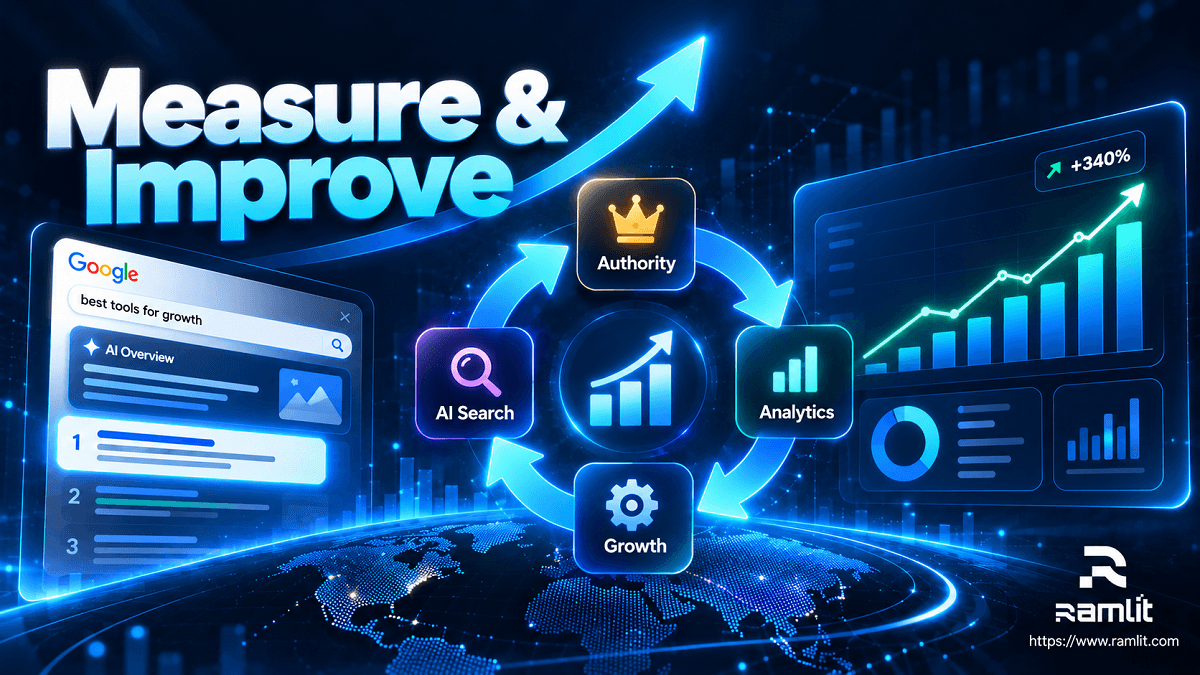
15. Measure Outcomes, Not Just Rankings
A ranking increase is useful only if it contributes to a business objective.
Your SEO dashboard should connect visibility to outcomes.
Search Metrics
Track:
- Impressions
- Clicks
- CTR
- Average position
- Indexed pages
- Query growth
- Landing-page traffic
Engagement Metrics
Track:
- Relevant engagement
- Scroll behavior
- Return visits
- Newsletter subscriptions
- Downloads
Business Metrics
Track:
- Qualified leads
- Demo requests
- Purchases
- Revenue
- Pipeline value
A page moving from:
Position 11 → Position 4
looks impressive.
But if the keyword has no commercial or strategic relevance, the business impact may be minimal.
Meanwhile, a page with only 200 visitors could generate five highly qualified leads.
SEO should be evaluated against business value.
16. Use Search Console to Find Existing Opportunities
You do not always need another keyword tool.
Search Console already tells you how Google is interacting with your content.
Look for queries where a page receives:
High impressions
+
Low CTR
Possible actions:
- Improve title clarity.
- Better align content with intent.
- Improve snippet relevance.
Another opportunity:
Positions 8–20
+
Relevant query
+
Strong page
Possible actions:
- Improve the relevant section.
- Add missing information.
- Strengthen internal links.
- Update stale facts.
- Improve user experience.
Existing search data is often more actionable than another list of thousands of theoretical keywords.
17. Refresh Content When There Is a Real Reason
Do not change:
2025 → 2026
and call that a content refresh.
Google's people-first guidance explicitly warns against changing dates or making large content changes primarily to appear fresh when the underlying information has not meaningfully changed. Google for Developers
Refresh a page when:
- Facts became outdated.
- Product features changed.
- Screenshots changed.
- Search intent evolved.
- Better sources became available.
- Competitors answer important questions you missed.
- Search Console reveals new relevant queries.
- Broken links or examples need replacement.
A good refresh should produce a meaningfully better page.
18. Create a Sustainable SEO Maintenance Cycle
SEO should not operate as:
Publish
↓
Forget
Use a review cycle.
Monthly
Review:
- Search Console trends
- Top landing pages
- Major traffic drops
- Indexing problems
- Conversions
Quarterly
Review:
- Important content
- Core Web Vitals
- Technical crawl
- Internal linking
- Competitor changes
- Conversion performance
Annually
Review:
- Site architecture
- Topic strategy
- Consolidation opportunities
- Old or obsolete content
- Major positioning changes
The original source recommends a phased process moving from technical foundations through competitive research, content development, authority building, distribution, and continuous maintenance. Pasted text
That phased thinking remains useful in 2026.
A Practical 90-Day SEO Roadmap
Days 1–14: Technical Baseline
Audit:
- Crawlability
- Indexability
- Status codes
- Canonicals
- Sitemap
- Internal links
- Core Web Vitals
- Mobile experience
Fix anything preventing important content from being properly accessed or indexed.
Days 15–30: Search Opportunity Mapping
Identify:
- Existing ranking queries
- Search-intent gaps
- Commercial pages
- Informational opportunities
- Pages competing for similar intents
- Competitor strengths and weaknesses
Build a keyword-to-page map.
Days 31–60: Content Improvement
Prioritize:
Existing page with opportunity
>
New article with uncertain demand
Improve content using:
- Better examples
- Original insight
- Clearer structure
- Accurate information
- Helpful visuals
- Internal links
Then create new content only where genuine gaps remain.
Days 61–75: Authority and Distribution
Promote your strongest resources through:
- Industry outreach
- Social channels
- YouTube
- Newsletters
- Partnerships
- Communities
- Digital PR
Do not manufacture links.
Create reasons to earn them.
Days 76–90: Measure and Refine
Analyze:
What gained impressions?
What gained clicks?
What produced leads?
What remained unchanged?
Why?
Then build the next 90-day cycle around evidence rather than assumptions.
SEO Prioritization Framework
When resources are limited, score potential work by:
| Factor | Question |
|---|---|
| Business value | Would ranking help generate meaningful business? |
| Search demand | Is there evidence people search for this? |
| Current opportunity | Are we already close to visibility? |
| Intent fit | Can our page genuinely satisfy the query? |
| Effort | How much work will improvement require? |
| Competitive strength | Can we reasonably compete? |
Then prioritize work with:
High business value
+
Strong intent match
+
Realistic opportunity
+
Reasonable effort
This prevents teams from spending months on impressive-looking keywords that have little chance of generating value.
Common SEO Mistakes to Avoid in 2026
Publishing More Because Traffic Fell
More pages do not automatically solve poor performance.
Diagnose first.
Treating AI Content as a Shortcut to Scale
AI can accelerate production.
It cannot replace editorial judgment, expertise, accuracy, and originality.
Writing to a Fixed Word Count
There is no universal ideal SEO article length.
Updating Dates Without Updating Content
Fresh timestamps do not replace meaningful improvements.
Treating Tool Scores as Google Metrics
SEO difficulty, domain authority, and similar numbers are third-party estimates.
Useful?
Yes.
Google ranking scores?
No.
Optimizing Only for Googlebot
A technically optimized page that frustrates users is still a weak page.
Obsessing Over Rankings Without Measuring Revenue
Visibility is a means.
Not the final business objective.
Treating AI Search as a Separate SEO Discipline
Google says the same core Search fundamentals remain relevant for AI features. Google for Developers
Frequently Asked Questions
How can I rank higher on Google in 2026?
Start with technical accessibility, understand the search intent, create a page that answers that intent better than the available alternatives, build clear internal connections, earn legitimate authority, and continuously measure performance.
There is no single tactic that guarantees rankings.
Is SEO still relevant with AI Overviews and AI Mode?
Yes.
Google states that its generative AI Search experiences continue to depend on its Search index, ranking systems, and quality systems, so established SEO practices remain relevant. Google for Developers
Does Google penalize AI-generated content?
Google does not frame the issue simply as "AI versus human."
Its guidance focuses on whether content is helpful, accurate, original, trustworthy, and created primarily for users. Large-scale automated content produced primarily to manipulate rankings can violate spam policies. Google for Developers
How many words should an SEO article have?
There is no preferred Google word count.
The article should be long enough to satisfy the user's intent without unnecessary filler. Google for Developers
Are Core Web Vitals ranking factors?
Google states that Core Web Vitals are used by its ranking systems, but they are only one part of overall page experience and good scores do not guarantee top rankings. Google for Developers
Does llms.txt improve Google rankings or AI visibility?
No.
Google clarified in 2026 that llms.txt is not required for Google Search and does not positively or negatively affect Search visibility or rankings. Google for Developers
How often should content be updated?
Update content when there is something meaningful to improve.
Examples include outdated facts, new product information, changed search intent, weak examples, new sources, or measurable performance decline.
Do not refresh pages solely to change their publication date.
SEO in 2026 Is a System, Not a Shortcut
Sustainable organic growth rarely comes from one trick.
It comes from alignment.
Crawlable pages
        +
Clear search intent
        +
Useful content
        +
Logical architecture
        +
Strong internal links
        +
Real authority
        +
Good user experience
        +
Accurate measurement
        +
Continuous improvement
        =
Stronger organic visibility
The biggest change in 2026 is not that traditional SEO stopped working.
It is that high-quality SEO now has more places to create value.
The same well-built page may be discovered through traditional search, AI experiences, images, video, or multimodal search.
That makes fundamentals more important, not less.
Build pages for real people.
Make them easy for search engines to discover and understand.
Demonstrate genuine expertise.
Measure what produces business value.
Improve content when there is a meaningful reason.
And resist strategies based on shortcuts, arbitrary tool scores, mass production, or promises of guaranteed rankings.
Ramlit Limited lists SEO, SEM, content marketing, and digital marketing among its current services, so businesses that need help auditing or improving their search strategy can use the company as the service-focused CTA for this article. ramlit.com
Let's Work Together
Looking to build AI systems, automate workflows, or scale your tech infrastructure? I'd love to help.
- Fiverr (custom builds & integrations): fiverr.com/s/EgxYmWD
- Portfolio: mejba.me
- Ramlit Limited (enterprise solutions): ramlit.com
- ColorPark (design & branding): colorpark.io
- xCyberSecurity (security services): xcybersecurity.io