
How to Win Customers with AI-Powered Google Search and Google Ads in 2026
Getting more clicks from Google is no longer enough.
A business can rank, appear inside an AI-generated answer, run Google Ads, generate dozens of leads—and still struggle to acquire profitable customers.
The reason is simple:
Google is increasingly optimizing around intent, context, and predicted outcomes rather than one keyword at a time.
On the organic side, Google AI experiences can expand a user's question into multiple related searches before constructing an answer.
On the advertising side, AI Max for Search campaigns can expand matching, customize ad copy, and—when enabled—select a relevant landing page from your website.
That changes the marketing problem.
You are no longer optimizing only:
Keyword
   ↓
Ranking
   ↓
Click
The modern customer-acquisition system looks closer to:
Customer problem
      ↓
Multiple related questions
      ↓
Google Search / AI experience
      ↓
Your content or ad
      ↓
Relevant landing page
      ↓
Trust + positioning
      ↓
Conversion
      ↓
Qualified lead
      ↓
Sale
      ↓
Revenue
The businesses that win will not necessarily be the ones generating the most traffic.
They will be the ones giving Google—and prospective customers—the clearest signals about:
- What they offer
- Who it is for
- Which problems they solve
- Why someone should trust them
- Which pages should be shown
- Which leads actually create business value
This guide explains how to build that system.
What Changed in Google Search?
Traditional SEO often began with a keyword.
For example:
best CRM for small business
A marketer would research that phrase, create a page, optimize it, build links, and attempt to rank.
That still matters.
But Google's AI search experiences can now go deeper.
Google AI Search Uses Query Fan-Out
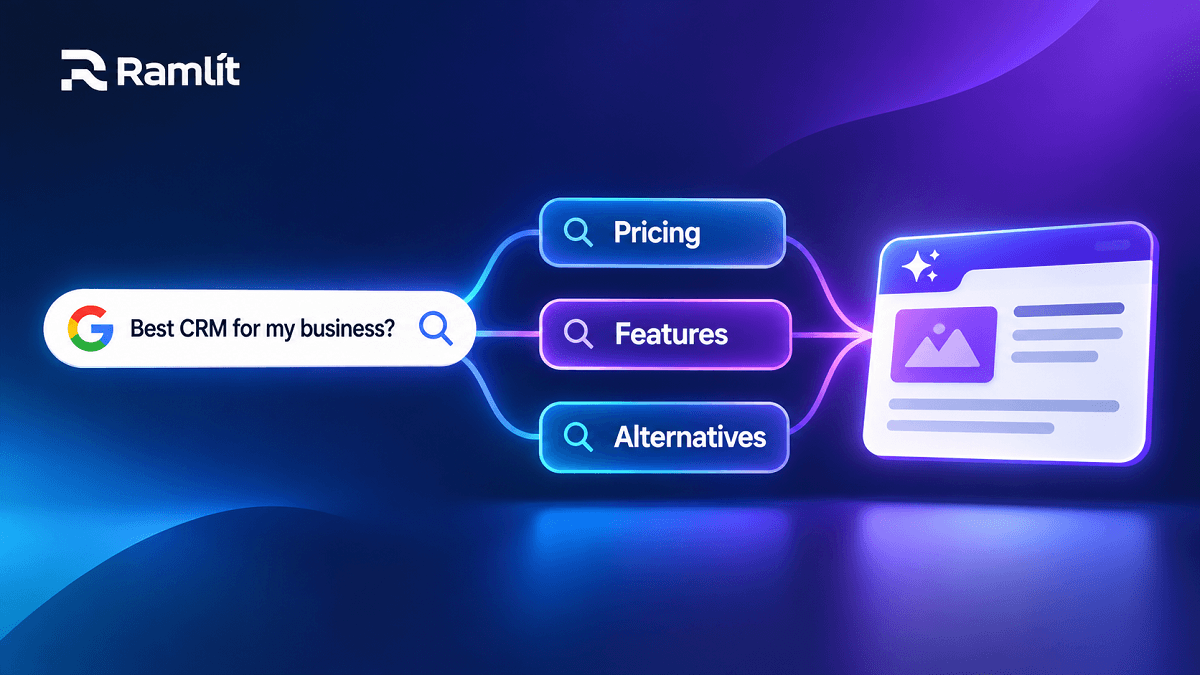
Google describes query fan-out as a process in which its AI systems generate multiple related searches to gather information needed to answer a user's original question.
Imagine a buyer asks:
What is the best CRM for a 20-person service company?
Google may need information related to:
CRM for 20-person teams
CRM pricing
CRM automation features
CRM for service companies
CRM implementation difficulty
CRM integrations
CRM customer support
CRM alternatives
The exact queries are generated dynamically, but the marketing lesson is important:
A page optimized around one isolated keyword may not answer enough of the buyer's real decision.
This does not mean keywords are dead.
It means keyword research needs to expand into buyer-question research.
For a deeper technical SEO framework, see Ramlit's internal guide:
How to Rank Higher on Google in 2026: A Practical SEO System for Sustainable Growth
Stop Building SEO Around One Keyword
Consider a company selling AI customer-support automation.
A narrow SEO strategy might target:
AI customer support chatbot
A buyer, however, may also need answers to:
Can AI handle customer support?

How much does an AI chatbot cost?

Can an AI chatbot connect to Zendesk?

Can AI access customer order information?

Is an AI chatbot secure?

What happens when the chatbot cannot answer?

AI chatbot vs live chat

How long does chatbot integration take?

Will AI replace support agents?

Can AI escalate tickets to humans?
These questions belong to different stages of the buying journey.
If your site answers only:
What is an AI chatbot?
you may attract informational traffic without helping the visitor make a purchase decision.
Map Content to Search Intent
A stronger content strategy maps information to the buyer's stage.
| Buyer Stage | Search Intent | Example |
|---|---|---|
| Problem aware | Understand the problem | Why is customer support expensive? |
| Solution aware | Explore solutions | How can AI automate customer support? |
| Product aware | Compare approaches | AI chatbot vs traditional chatbot |
| Vendor evaluation | Evaluate providers | Best AI chatbot development company |
| Decision | Reduce buying risk | AI chatbot development cost and timeline |
| Conversion | Take action | Hire AI chatbot developer |
This gives Google more useful information.
More importantly, it gives the customer a path toward a decision.
Build Topic Coverage Around the Buyer
Instead of publishing five disconnected articles, create an intentional journey.
For example:
What is AI customer support?
        ↓
How AI customer support works
        ↓
AI chatbot integrations
        ↓
AI chatbot security
        ↓
AI chatbot pricing considerations
        ↓
Custom vs SaaS chatbot
        ↓
AI chatbot development service
        ↓
Request consultation
Internal links should naturally connect these stages.
That is how informational content can contribute to customer acquisition rather than simply generating page views.
Write Passages That Answer Real Questions Clearly
AI search systems frequently retrieve specific information from pages rather than treating every page as one indivisible document.
That makes clarity more important.
Consider this weak paragraph:
Our solution offers powerful capabilities designed to transform the way modern businesses operate and provide exceptional experiences.
It says almost nothing.
A stronger passage would be:
An AI customer-support chatbot can answer common questions using approved company documentation, retrieve account information through authorized APIs, create support tickets, and transfer complex cases to a human agent. The exact capabilities depend on the chatbot's integrations and permission model.
That paragraph works because it clearly explains:
- The subject
- What it does
- How it works
- Its limitations
It can stand on its own without forcing the reader to interpret vague marketing language.
Self-Contained Does Not Mean Robotic
Do not turn every paragraph into an encyclopedia entry.
The goal is clarity.
Use:
Specific subject
+
Direct answer
+
Relevant context
+
Limitation when necessary
Avoid:
Generic claim
+
Buzzwords
+
No evidence
+
No practical meaning
Build Content That Helps Someone Buy
Traffic-focused SEO often stops once the question is answered.
Buyer-focused SEO asks:
What does the visitor need to understand next?
Imagine someone searches:
How much does custom software development cost?
A useful page should not simply say:
It depends.
It should explain which variables affect cost:
- Scope
- Integrations
- User roles
- Data complexity
- Security requirements
- Infrastructure
- Testing
- Maintenance
Then give the visitor a logical next step.
For example:
Understand pricing factors
        ↓
See common project scopes
        ↓
Understand development process
        ↓
Review relevant capabilities
        ↓
Discuss project requirements
That is search-intent optimization and conversion optimization working together.
Make Your Brand Positioning Easy for AI—and Humans—to Understand
Visibility is not enough.
Imagine an AI system mentions your company when someone asks:
What company can build an enterprise AI automation platform?
That sounds positive.
But what if your business is consistently associated with:
Cheap chatbot setup for very small websites.
You may be visible but positioned for the wrong customer.
This is why brand positioning matters.
Your Website Should Clearly Explain
Who you help
+
What you build
+
Which problems you solve
+
Which technologies/capabilities matter
+
What level of project you handle
+
What the buyer should do next
For example, compare:
We provide innovative digital solutions for businesses worldwide.
with:
We build AI automation, custom software, cloud systems, and digital products for businesses that need scalable technology and workflow improvements.
The second statement provides far more useful context.
Avoid Trying to Rank for Everyone
If your ideal customer is:
A growing company needing custom AI automation connected to its CRM and internal systems
your website should not be written as if your primary customer is:
Someone looking for the cheapest $20 chatbot.
Search visibility without customer alignment can create traffic that never converts.
Google Ads Is Becoming More Dependent on Your Website
This is one of the most important changes for advertisers.
Google's AI Max for Search campaigns can use information from:
- Existing advertisements
- Keywords
- Landing pages
- Website content
- Other campaign signals
to help determine how advertisements should match search intent.
When text customization is enabled, Google can create additional headlines and descriptions grounded in campaign and landing-page information.
When Final URL expansion is enabled, Google can send a user to another relevant page on your domain when it predicts that page is a stronger match for the search.
That means your website is becoming part of the advertising engine.
Your Website Is Now Ad Inventory
Historically, an advertising team could tightly control:
Keyword
↓
Ad
↓
Landing page
AI Max can create a more dynamic path:
Search
↓
Google AI evaluates intent
↓
Matching expands
↓
Ad messaging adapts
↓
Relevant page selected
↓
Visitor lands on your website
This can create opportunities.
It can also expose problems.
Suppose your site still contains:
Old pricing page

Discontinued service

Outdated offer

Weak blog post

Old promotional landing page

Page targeting the wrong customer

Unverified claim
If Google has permission to use the page within campaign optimization, poor content governance can affect paid customer journeys.
Audit Your Website Before Giving Google More Automation
Before enabling broader URL expansion, classify important pages.
A practical framework is:
| Page Type | Advertising Decision |
|---|---|
| Current commercial landing page | Usually eligible |
| Current service page | Usually eligible |
| High-intent comparison page | Evaluate |
| Helpful buyer guide | Evaluate |
| Outdated service | Exclude/update |
| Old promotion | Exclude/remove |
| Legal/privacy page | Usually exclude |
| Thin archive/tag page | Usually exclude |
| Irrelevant blog article | Exclude where appropriate |
Google Ads provides URL controls and exclusions for AI Max.
Use them.
Do not assume:
AI will automatically understand which pages we never want customers to see.
Automation still needs governance.
Your Organic Content and Paid Ads Are Becoming More Connected
This creates an interesting consequence.
SEO teams can no longer think:
The blog is only for organic traffic.
Google Ads teams can no longer think:
Only our dedicated landing page matters.
Your entire website influences:
- Brand perception
- Search discovery
- AI understanding
- Ad asset generation
- Landing-page selection
- Conversion experience
A strong content architecture can therefore support both organic and paid acquisition.
For a deeper breakdown of the economics behind paid acquisition, read:
Why Google Ads Campaigns Lose Money—and How to Build Profitable Campaigns
Do Not Optimize Google Ads for Every Lead Equally
One of the most expensive mistakes in lead-generation advertising is treating every form submission as equally valuable.
Imagine an IT company receives two inquiries.
Lead A
Single-page website
Budget: $300
No defined timeline
Lead B
Multi-location company
Needs custom business software
CRM integration required
Qualified budget
Decision-maker involved
If Google Ads receives only:
Form submission = conversion
both customers may look identical to the bidding system.
But they are not identical to the business.
Send Qualified Lead Outcomes Back to Google
Google Ads supports qualified lead and converted lead goals.
This lets businesses send downstream sales outcomes back into the advertising system.
A better measurement flow might be:
Ad click
   ↓
Form submitted
   ↓
Lead created
   ↓
Sales team reviews
   ↓
Qualified lead
   ↓
Proposal
   ↓
Customer
Instead of optimizing only for:
Form submission
your system can eventually learn from:
Qualified lead
or:
Converted customer
depending on your volume, attribution setup, sales cycle, and bidding strategy.
Enhanced Conversions for Leads Matters
Google's current lead-measurement workflow supports enhanced conversions for leads.
This can help connect offline sales outcomes back to advertising interactions using first-party customer information and click identifiers where available.
For example:
Google Ad
   ↓
Lead form
   ↓
CRM
   ↓
Sales qualification
   ↓
Deal won
   ↓
Outcome returned to Google Ads
This closes a gap that many businesses still have.
Their advertising platform knows:
Someone filled out a form.
But it does not know:
The lead was completely irrelevant.
or:
This lead became a $30,000 customer.
Without that information, bidding optimization may focus on lead quantity instead of customer value.
Use Conversion Values Carefully
Not every business can assign an exact value immediately.
But you can create meaningful distinctions.
For example:
Basic inquiry = 1

Qualified opportunity = 10

Sales-qualified opportunity = 30

Closed customer = actual revenue or modeled value
The values should reflect your own economics.
Do not copy arbitrary values from another company's marketing tutorial.
Google's value-based bidding works best when the values you send represent meaningful business differences.
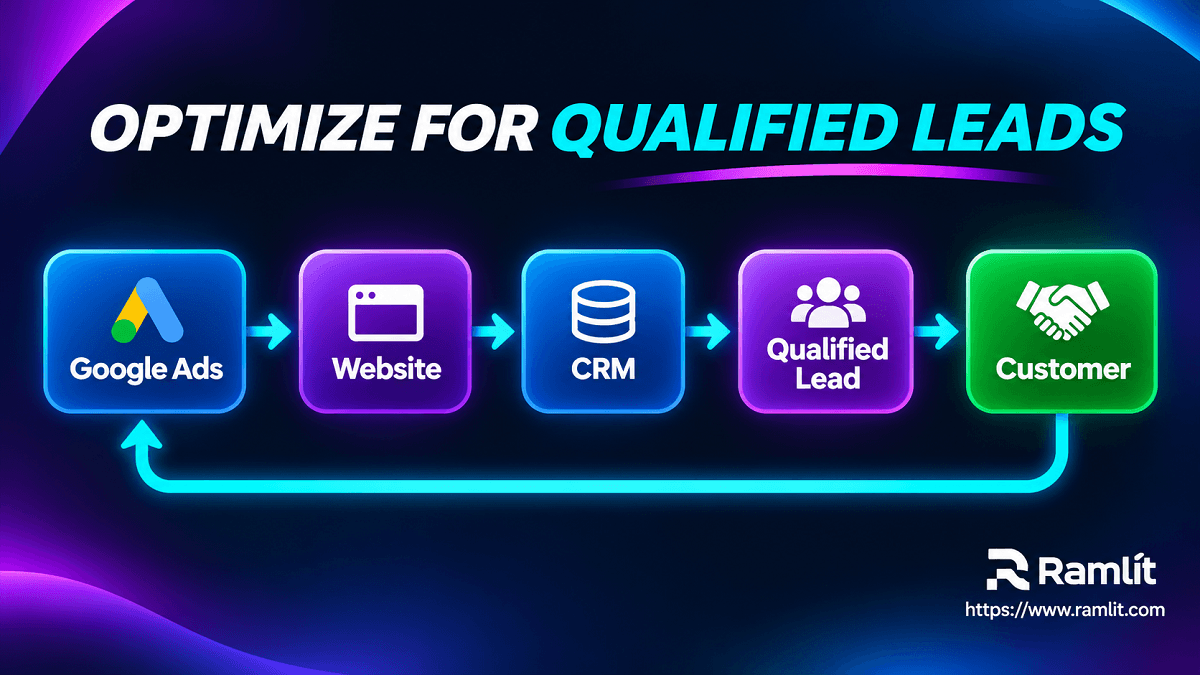
Connect Marketing to Your CRM
This is where marketing automation becomes increasingly valuable.
A mature system may connect:
Google Ads
   ↓
Website
   ↓
CRM
   ↓
Sales qualification
   ↓
Customer outcome
   ↓
Google Ads
You can automate parts of that workflow while keeping important business decisions under human control.
Ramlit's related guide explains this broader principle:
AI Business Automation in 2026: A Practical Guide to Automating Workflows and Productivity
Track Visibility, Consideration, and Conversion Separately
One of the biggest measurement mistakes in AI search is treating visibility as the final objective.
These are different stages.
Stage 1: Visibility
Questions:
Does our site appear?

Are our pages being surfaced?

Are we receiving AI Search impressions?
Google Search Console now provides dedicated generative AI performance reporting covering visibility in AI Overviews and AI Mode.
This is useful for understanding whether your pages are appearing within Google's generative search experiences.
But visibility alone does not prove that Google is persuading someone to buy from you.
Stage 2: Consideration
The next question is:
Does our positioning make us a credible option for the buyer?
This is harder to reduce to one Google metric.
You can investigate it through:
- Landing-page behavior
- Brand searches
- Customer interviews
- Sales conversations
- Search query patterns
- AI-answer testing
- Comparison-page engagement
- Returning visitors
You can also manually test commercially relevant AI queries to understand how your business is positioned.
For example:
Best AI automation companies for SaaS

Who can build a custom AI agent?

Best company for Laravel SaaS development

AI automation agency for enterprise workflows
Do not treat one AI response as a ranking report.
Responses can vary.
Use repeated testing to identify positioning patterns.
Stage 3: Conversion
Finally:
Did the visitor become a lead?

Was the lead qualified?

Did the opportunity progress?

Did the customer buy?

Was the customer profitable?
That is the stage where business value becomes real.
Use This Measurement Framework
Instead of one dashboard filled with traffic metrics, structure performance like this:
| Layer | Example Metrics |
|---|---|
| Visibility | Search impressions, AI visibility, paid impressions |
| Engagement | Clicks, relevant landing-page engagement |
| Intent | Pricing views, service views, demo interest |
| Conversion | Leads, purchases, calls |
| Qualification | Qualified leads, opportunities |
| Revenue | Closed sales, revenue, margin |
| Retention | Repeat purchases, renewals, lifetime value |
This makes diagnosis easier.
For example:
High visibility + low clicks
Possible problem:
- Weak positioning
- Poor title/snippet
- Search intent mismatch
High clicks + low conversions
Possible problem:
- Weak landing page
- Poor offer
- Trust problem
- Wrong audience
High leads + low qualification
Possible problem:
- Targeting too broad
- Messaging attracts wrong customer
- Weak qualification
Qualified leads + weak sales
Possible problem:
- Sales process
- Pricing
- Offer
- Follow-up
- Product fit
More traffic will not automatically fix any of these.
Conversion Optimization Matters More as AI Improves Traffic Acquisition
As Google becomes better at matching users with content and advertisements, businesses need to become better at converting that attention.
Do not rely on unsupported claims such as:
CRO produces exactly 68% of revenue impact.
There is no universal percentage that applies to every business.
The principle is simpler.
Suppose you receive:
10,000 visitors
×
1% conversion rate
=
100 conversions
If you improve the conversion rate to 2%:
10,000 visitors
×
2%
=
200 conversions
You doubled conversions without doubling traffic.
This is why acquisition and conversion should be optimized together.
Build Landing Pages Around Buyer Decisions
A conversion-focused page should answer:
Is this relevant to me?

Can you solve my problem?

How does it work?

What do I receive?

Why should I trust you?

What does it require from me?

What happens next?
A strong page commonly needs:
- Clear headline
- Specific audience/problem
- Relevant solution
- Practical benefits
- Capability details
- Evidence where available
- FAQs
- Objection handling
- Clear CTA
Avoid:
Transform Your Future With Cutting-Edge Innovation
unless the following content immediately explains what you actually do.
Specificity converts better than vague sophistication.
Create Content for Commercial Questions
Informational traffic has value.
But if your business objective is customer acquisition, your content portfolio should also address buying questions.
For example:
Informational
What is AI automation?
Commercial
AI automation vs traditional workflow automation

How much does AI automation cost?

Best AI automation platforms

Custom AI automation vs Zapier

AI automation agency vs in-house team
Transactional
AI automation development services

Hire AI automation developer

Custom AI agent development company
Your content strategy should cover all three.
Otherwise you may build authority without creating a path to purchase.
Build Pages That Support Each Other
A strong internal-link structure might look like:
Educational article
        ↓
Detailed guide
        ↓
Comparison article
        ↓
Case study / proof
        ↓
Service page
        ↓
Inquiry
Internal linking should be useful rather than mechanical.
Do not insert the same commercial page every three paragraphs.
Link when the next resource genuinely helps the buyer.
Six Rules for Winning Customers Through AI-Powered Google
Rule 1: Optimize Around Buyer Questions, Not One Keyword
Map the full information journey surrounding your customer's decision.
Use search queries, sales conversations, support questions, Search Console, competitor analysis, and customer interviews to identify those questions.
Rule 2: Make Important Answers Specific and Self-Contained
Avoid vague marketing language.
Write passages that clearly explain:
What?
Who?
How?
When?
Limitations?
Next step?
Rule 3: Make Your Positioning Unambiguous
Teach both customers and search systems:
- Who you serve
- What you offer
- Which problems you solve
- Why you are relevant
Visibility to the wrong buyer is not success.
Rule 4: Govern What Google Ads Can Use
If you use AI Max:
- Review generated assets
- Review landing-page behavior
- Audit old pages
- Configure URL exclusions
- Keep offers accurate
- Remove obsolete information
Your website is now part of the ad-generation system.
Rule 5: Optimize for Qualified Customers
Connect advertising data with CRM outcomes.
Where appropriate, return:
Qualified lead
Converted lead
Conversion value
to Google Ads.
Give the bidding system better information about what your business actually values.
Rule 6: Measure the Entire Funnel
Do not stop at:
Ranking
or:
AI visibility
or:
Lead
Measure:
Visibility
   ↓
Engagement
   ↓
Consideration
   ↓
Conversion
   ↓
Qualification
   ↓
Revenue
A 30-Day Implementation Plan
Week 1: Search and Content Audit
Identify:
- Highest-value products/services
- Buyer personas
- Important commercial queries
- Existing rankings
- AI Search visibility
- Content gaps
- Outdated pages
Build a buyer-question map.
Week 2: Improve Commercial Content
Update:
- Service pages
- Product pages
- Comparison pages
- FAQ sections
- Pricing explanations
- Internal links
Make each important page clearly answer:
Who is this for?

What problem does it solve?

Why choose this approach?

What should the visitor do next?
Week 3: Audit Google Ads and Landing Pages
Review:
- AI Max configuration
- Search-term matching
- Text customization
- Final URL expansion
- URL exclusions
- Generated assets
- Landing-page accuracy
Remove pages you do not want Google using for paid traffic.
Week 4: Connect Sales Outcomes
Review tracking from:
Ad
↓
Lead
↓
CRM
↓
Qualified lead
↓
Customer
Where appropriate, implement enhanced conversions for leads and send meaningful downstream outcomes back to Google Ads.
Then build reporting around qualified business outcomes rather than raw lead volume.
Questions to Ask Before Scaling Your Google Marketing Budget
Before spending more, answer these questions:
- Which customer segments generate the highest value?
- Which searches indicate strong buying intent?
- Does our website answer the questions those buyers ask?
- Does Google understand who our offer is for?
- Are old or irrelevant pages influencing our advertising?
- Can we distinguish a raw lead from a qualified opportunity?
- Does Google Ads receive meaningful sales outcomes?
- Which landing pages convert qualified customers?
- Where does the funnel lose people?
- Would more traffic actually solve our current problem?
If the answer to question ten is no, increasing advertising spend may simply amplify the bottleneck.
Frequently Asked Questions
What is query fan-out in Google AI Search?
Query fan-out is Google's process of generating multiple related searches around a user's original question to retrieve additional information for an AI-generated response.
For marketers, this means content strategy should address the broader set of questions surrounding the buyer's intent rather than depending entirely on one keyword.
Does traditional SEO still matter for AI Overviews and AI Mode?
Yes.
Google's guidance continues to position traditional SEO fundamentals as relevant to its generative search experiences.
Important foundations still include:
- Crawlability
- Indexability
- Useful content
- Internal linking
- Page experience
- Structured information
- Trustworthy content
What is AI Max for Google Search Ads?
AI Max is an optimization layer for Search campaigns that can use AI-powered search-term matching and asset optimization.
Depending on configuration, it can expand matching, customize ad text, and use Final URL expansion to select relevant pages from your website.
Can Google create ad copy from my website?
When text customization is enabled within AI Max, Google can generate additional headlines and descriptions using context that includes landing-page content, domain information, existing ads, keywords, and other campaign inputs.
This is why keeping website content accurate matters.
Can Google choose a different landing page?
If Final URL expansion is enabled, Google can route traffic to another relevant URL on your domain when its systems predict that page better matches the query and campaign context.
Advertisers can use URL controls and exclusions.
Should every lead have the same conversion value?
Not necessarily.
If different leads have substantially different business value, treating every conversion identically can provide weak optimization signals.
Qualified leads, converted leads, and conversion values can help advertisers align campaign optimization more closely with real business outcomes.
How can I track AI Search performance?
Google Search Console now provides generative AI performance reporting for visibility within AI Overviews and AI Mode.
Use that alongside normal Search Console performance data, analytics, CRM reporting, and conversion tracking.
AI visibility should be treated as one stage of the acquisition funnel—not the final business KPI.
Does appearing in an AI answer mean Google recommends my business?
No.
Visibility, recommendation or consideration, and conversion are different concepts.
A page may appear as a supporting source without the user's final decision favoring that company.
Track the entire journey.
The New Google Marketing Strategy Is About Customer Value
AI is making Google Search and Google Ads more dynamic.
Search can explore related questions.
Ads can adapt messaging.
Landing-page selection can become more automated.
Bidding can incorporate deeper conversion signals.
But none of these systems can compensate for an unclear business.
If your website contains vague positioning, outdated pages, weak offers, poor conversion paths, and conversion tracking that treats every inquiry equally, adding more AI may simply automate the wrong signals.
A stronger system looks like:
Clear positioning
       ↓
Buyer-intent content
       ↓
AI Search visibility
       ↓
Relevant ads
       ↓
Relevant landing page
       ↓
Strong conversion experience
       ↓
Qualified lead
       ↓
Sales outcome
       ↓
Feedback into marketing
       ↺
That is the opportunity.
Do not optimize only for rankings.
Do not optimize only for clicks.
Do not optimize only for form submissions.
Optimize for the customer your business actually wants.
Then give Google better content, better landing pages, and better conversion data to help find more people like them.
Need Help Turning Google Traffic Into Qualified Customers?
Ramlit Limited provides Digital Marketing & SEO services covering SEO, performance advertising, content, analytics, and conversion-focused digital strategy.
If your business is receiving traffic but struggling to convert it into qualified opportunities, the first step should be identifying where the acquisition funnel is actually breaking.